Daniel Banes
Francesco Giorgi was a Franciscan friar who wrote 'De harmonia mundi', exploring universal proportions and Christian Cabala.
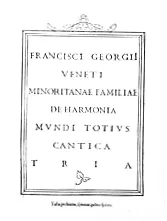
Francesco Giorgi Veneto (1466–1540) was an Italian Minim friar and philosopher known for his work "De harmonia mundi totius" (1525). In this book, Giorgi presented a concept of the universe structured by universal mathematical proportions, akin to principles used in architecture. The Cambridge History of Renaissance Philosophy characterized his approach as 'idiosyncratic'. He also authored "In Scripturam Sacram Problemata" (1536).
Giorgi is recognized as a Christian Cabalist, meaning he believed that Jewish Kabbalistic literature could validate the truths of Christianity. His writings have been discussed in relation to figures like Frances Yates and have been theorized to have influenced playwrights such as Shakespeare, as suggested by Daniel Banes' theory regarding Shakespeare's familiarity with Giorgi's Cabalistic works and related texts. Copies of Giorgi's "De harmonia mundi" were held in the libraries of notable figures like Sir Thomas Browne and John Dee.
Cosmology and Universal Proportion
Francesco Giorgi's seminal work, "De harmonia mundi totius" (1525), delves into a philosophical understanding of the cosmos based on universal systems of proportion. He posited that the universe was created according to mathematical laws, principles that could be studied and understood, much like those governing architectural design. This perspective aligns with Renaissance philosophical interests in numerology, geometry, and the underlying order of creation. The Cambridge History of Renaissance Philosophy has described Giorgi's intellectual contributions as 'idiosyncratic', suggesting a unique and perhaps unconventional approach to these profound subjects.
Christian Cabalism and Religious Synthesis
Giorgi is identified as a Christian Cabalist, a designation that signifies more than a mere interest in Jewish mystical literature. For Giorgi, Kabbalah served as a means to demonstrate or confirm the tenets of Christianity. This approach reflects a broader Renaissance trend of seeking esoteric knowledge to reconcile different religious and philosophical traditions. His belief in the potential of Kabbalah to prove Christian doctrines highlights his role in the intellectual landscape of the period, where figures sought to integrate diverse mystical and theological systems. This facet of his work has been a subject of scholarly attention, particularly in understanding the cross-pollination of ideas between Jewish mysticism and Christian thought.
Influence and Legacy
The intellectual impact of Francesco Giorgi extends to discussions of later Renaissance figures and their works. Scholar Frances Yates extensively discusses Giorgi in "The Occult Philosophy in the Elizabethan Age," exploring his contributions to esoteric thought. Furthermore, Daniel Banes proposed a theory suggesting that playwrights like Shakespeare may have been familiar with Giorgi's writings on the Cabala and similar texts, particularly in relation to works such as Shakespeare's "The Merchant of Venice." The presence of Giorgi's "De harmonia mundi" in the libraries of prominent collectors like Sir Thomas Browne and John Dee further underscores his significance and the circulation of his ideas among learned individuals of the era.
Key Ideas
- The universe is structured according to universal mathematical proportions.
- Kabbalah can be used to prove the truth of Christianity (Christian Cabalism).
- Mathematical laws govern the creation and harmony of the cosmos.
Books by Daniel Banes
1 free public domain book · Read online or download