Columba Stewart
The Book of Kells is an ornate Celtic Gospel book from around 800 AD, renowned for its elaborate illustrations and complex artistry.
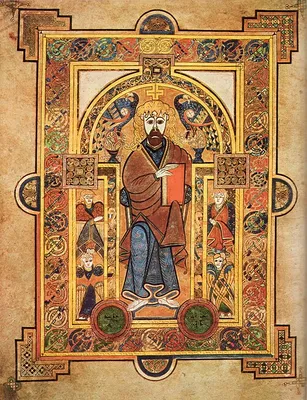
The Book of Kells, also known as the Book of Columba, is a masterfully crafted Celtic Gospel book created in a Columban monastery, likely in Scotland, around 800 AD. It contains the four Gospels of the New Testament, along with introductory texts and tables, drawing from both the Vulgate and earlier Vetus Latina biblical versions. The manuscript is celebrated as a peak of Western calligraphy and Insular illumination, distinguished by its exceptionally intricate illustrations and ornamentation. These decorations blend traditional Christian imagery with the swirling, interlace patterns characteristic of Insular art, featuring human figures, animals, mythical beasts, and Celtic knots in vibrant colors, many imbued with symbolic meaning.
The manuscript, currently housed at Trinity College Library in Dublin, consists of 340 vellum leaves, bound in four volumes. Its creation is believed to have occurred within Columban institutions in Scotland and Ireland, with Iona Abbey and Kells Abbey being key locations in its history. While traditionally thought to be connected to St. Columba, scholarly consensus places its creation around 800 AD, long after his death. The Book of Kells is considered a significant artifact of Insular art, reflecting artistic and textual traditions shared with other illuminated manuscripts from the period.
Artistic and Scriptural Significance
The Book of Kells stands out among Insular Gospel books for its unparalleled extravagance and complexity in illustration and ornamentation. Its decoration masterfully combines Christian iconography with the distinctive swirling motifs of Insular art. The pages are enlivened with depictions of humans, animals, and mythical creatures, alongside intricate Celtic knots and interlacing patterns rendered in vivid colors. Many of these decorative elements carry Christian symbolism, reinforcing the themes of the major illustrations. The manuscript's text, written in Insular majuscule script, is attributed to at least three different scribes and uses iron gall ink. The vibrant colors were produced from a variety of substances, some sourced from distant regions, highlighting the extensive resources and skill involved in its creation.
Origin and Historical Context
The precise origin and date of the Book of Kells remain subjects of scholarly debate, though it is generally placed in the late 8th or early 9th century. It is believed to have been produced in a Columban monastery, with a widely accepted theory suggesting it was begun at Iona Abbey and completed at Kells Abbey, which was founded from Iona. The manuscript is a prime example of Insular art, a style flourishing in monasteries across Britain and Ireland from the late 6th to the early 9th centuries. The creation of such illuminated manuscripts was deeply connected to the preservation of Latin and the practice of monastic life, influenced by figures like Cassiodorus who promoted the study and copying of texts within monasteries.
Medieval History and Preservation
The Book of Kells has a documented history stretching back to at least 1007 AD, when an entry in the Annals of Ulster records the theft of the "great Gospel of Columkille" from Kells Abbey, noting its recovery minus its ornate shrine. This incident is widely assumed to refer to the Book of Kells and suggests its presence in Kells by that date. The manuscript's survival through numerous Viking raids on Kells Abbey in the early 9th century remains unknown. Later, in the 12th century, blank pages of the book were used for copying land charters related to Kells Abbey, providing concrete evidence of its location. Following ecclesiastical reforms, Kells Abbey was dissolved, and the book remained in the abbey church, which became a parish church.
Key Ideas
- Insular art style
- Celtic knotwork and interlacing patterns
- Hiberno-Scottish monastic traditions
- Gospel book illumination
Notable Quotes
“This book contains the harmony of the Four Evangelists according to Jerome, where for almost every page there are different designs... and other forms almost infinite... Fine craftsmanship is all about you, but you might not notice it. Look more keenly at it and you will penetrate to the very shrine of art. You will make out intricacies, so delicate and subtle, so exact and compact, so full of knots and links, with colours so fresh and vivid, that you might say that all this was the work of an angel, and not of a man.”
Books by Columba Stewart
1 free public domain book · Read online or download