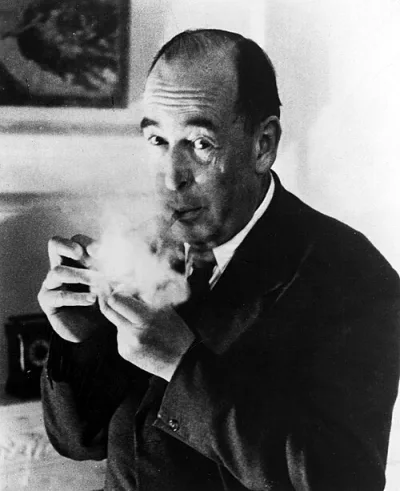
C.S. Lewis was a British author, scholar, and theologian known for Narnia, Christian apologetics, and his intellectual journey.
Clive Staples Lewis, born in 1898, was a prolific British author, literary scholar, and Anglican lay theologian. He held academic posts at Oxford and Cambridge, becoming widely recognized for his imaginative fiction, including The Chronicles of Narnia, The Screwtape Letters, and The Space Trilogy. Lewis also made significant contributions to Christian apologetics with works like Mere Christianity. His writings and wartime radio broadcasts on faith brought him considerable acclaim.
Lewis's personal faith journey significantly influenced his work. After a period of atheism in his youth, he returned to Anglicanism, a decision shaped by his close friendship with J.R.R. Tolkien and other intellectual circles like the Inklings. His literary output, exceeding thirty books translated into numerous languages, has sold millions of copies and continues to be studied by Christian scholars across denominations. Lewis passed away in 1963 and was later memorialized in Westminster Abbey.
Early Life and Intellectual Development
Born in Belfast, Clive Staples Lewis experienced a childhood marked by early fascination with stories and mythology. His early years involved a move to England for schooling after his mother's death. During his time at Cherbourg House and later Malvern College, Lewis drifted away from his childhood Christian faith, embracing atheism and developing interests in European mythology and the occult. He was influenced by Norse sagas and Greek literature, which he studied under William T. Kirkpatrick. This period also saw him develop a deep appreciation for nature and experiment with creative writing, including tales of anthropomorphic animals and epic poetry.
Irish Identity and Literary Influences
Lewis maintained a complex relationship with his Irish heritage, experiencing initial cultural shock upon arriving in England. He developed a strong admiration for Irish mythology and writers like W.B. Yeats, considering aligning himself with the "Irish school" of literature early in his career. While he expressed some playful criticism of English culture, he also sought out the company of other Irish people and regularly visited Northern Ireland. Critics have suggested that his ecumenical approach to Christianity and emphasis on core beliefs, as articulated in 'Mere Christianity', may have been influenced by his experiences of sectarian conflict in Belfast.
Scholarly Career and Spiritual Reawakening
Lewis entered Oxford University in 1917, joining the army during World War I and serving in France. Following his military service, he returned to academia, holding influential positions in English literature at Magdalen College, Oxford, and later Magdalene College, Cambridge. His academic career was paralleled by a profound spiritual reawakening. Influenced by friends such as J.R.R. Tolkien, Lewis returned to Christianity and became an active layman in the Church of England. This renewed faith became a central theme in his prolific writing, shaping his theological arguments and imaginative narratives.
Key Ideas
- Christian apologetics
- The concept of 'joy' as an intense longing
- Mere Christianity as core shared beliefs among denominations
- The influence of mythology and Northernness
Books by
6 free public domain books · Read online or download