Clayton Schonberger
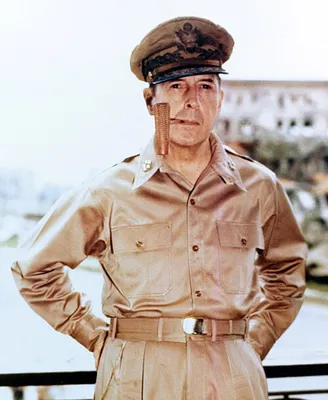
Douglas MacArthur was a distinguished American general with a long career in military leadership and public service.
Douglas MacArthur was a prominent American general who achieved the rank of General of the Army. His extensive military career spanned World War I, World War II, and the Korean War. He held significant leadership positions, including Chief of Staff of the U.S. Army and Supreme Commander for the Allied Powers overseeing the occupation of Japan. MacArthur's service also included commanding U.S. forces in the Far East, leading campaigns in the Southwest Pacific, and heading the United Nations Command during the Korean War. He received numerous accolades for his service, including the Medal of Honor. Beyond his military roles, MacArthur was involved in the administration of the U.S. Military Academy and advised the Commonwealth of the Philippines. He also made a bid for the Republican presidential nomination and later served as chairman of a corporation.
Early Life and Military Beginnings
Born in 1880, Douglas MacArthur was the son of Arthur MacArthur Jr., a Medal of Honor recipient. He grew up on various Army posts, developing early skills in riding and shooting. MacArthur graduated first in his class from the U.S. Military Academy at West Point in 1903, commissioned into the Corps of Engineers. His early career included postings in the Philippines, where he supervised construction and conducted surveys, and a period as aide-de-camp to his father in Asia, touring military bases and various countries. He later commanded troops and served in leadership roles within the Engineer School before his father's death necessitated a transfer to care for his mother.
World War I and Interwar Service
During World War I, MacArthur rose to brigadier general on the Western Front, earning multiple honors including the Distinguished Service Cross and the Silver Star. Following the war, he served as Superintendent of the U.S. Military Academy from 1919 to 1922. His career continued with postings in the Philippines, where he played a role in quelling a mutiny. In 1925, he became the Army's youngest major general. From 1930 to 1935, MacArthur served as Chief of Staff of the U.S. Army, during which time he was involved in the controversial expulsion of Bonus Army protesters and organized the Civilian Conservation Corps. He then served as Military Advisor to the Commonwealth of the Philippines, retiring from the Army in 1937 but continuing as an advisor and holding the rank of Field Marshal in the Philippine Army.
World War II and Post-War Command
MacArthur was recalled to active duty in 1941 as commander of U.S. Army Forces in the Far East. After initial setbacks in the Philippines, he escaped to Australia and was appointed Supreme Commander of the Southwest Pacific Area. He led campaigns in New Guinea and returned to liberate the Philippines, earning the Medal of Honor for his defense of the islands. Promoted to General of the Army in 1944, he accepted Japan's surrender in 1945. As Supreme Commander for the Allied Powers, he oversaw Japan's occupation, including war crimes trials and significant reforms like introducing women's rights and civil liberties.
Korean War and Later Life
During the Korean War, MacArthur commanded the United Nations Command. Despite initial successes, his forces faced major defeats after China's intervention. His command in Korea was controversially terminated by President Truman in 1951. Following his military career, MacArthur made a brief attempt to secure the Republican Party's nomination for president in 1948. He later became chairman of the board of Remington Rand. Douglas MacArthur died in 1964 in Washington, D.C.
Notable Quotes
“I learned to ride and shoot even before I could read or write—indeed, almost before I could walk and talk.”
“Preparedness is the key to success and victory.”
Books by Clayton Schonberger
2 free public domain books · Read online or download