Christopher Marlowe
Christopher Marlowe was a renowned Elizabethan playwright whose life was as dramatic and mysterious as his works, possibly involving espionage and controversial beliefs.
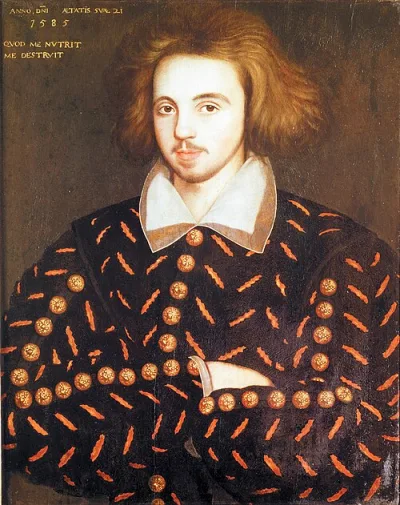
Christopher Marlowe, born in 1564, was a prominent English playwright, poet, and translator of the Elizabethan era, considered by modern scholars to be London's leading dramatist prior to his untimely death in 1593. His writing is noted for its use of blank verse, which became standard for the period, and for its complex protagonists who often exhibit hubris. Marlowe's plays explored humanistic themes with realistic emotions, yet also incorporated graphic violence and cruelty, a combination some find challenging to reconcile with his personal life. The circumstances surrounding his death are shrouded in mystery, with various theories including bar fights, political intrigue, and espionage, none of which have been definitively resolved by historical documentation.
Early Life and Education
Christopher Marlowe was born in Canterbury in 1564, the son of a shoemaker. He received a scholarship to The King's School and later attended Corpus Christi College, Cambridge, initially with the expectation of becoming an Anglican clergyman. He earned his Bachelor of Arts degree in 1584, mastering Latin and translating classical works. His Master of Arts degree was delayed in 1587 due to rumors he planned to study at a Catholic seminary in France, an act that would have been illegal under Queen Elizabeth I. Despite this, his degree was awarded after intervention from the Privy Council, who commended his 'faithful service' to the Queen. This intervention has led to speculation that Marlowe was involved in secret government work, possibly as a spy for Sir Francis Walsingham, though the exact nature of his service remains unclear.
Adult Life, Espionage, and Philosophy
Marlowe's adult life is sparsely documented, primarily through legal records, leading to extensive speculation about his character and activities. He has been described in various ways, including as a spy, brawler, and heretic, with some scholars arguing against the more sensational claims while others find them plausible. His alleged involvement in government espionage is a significant area of conjecture, possibly beginning during his Cambridge years. Unusual absences from the university and lavish spending suggest activities beyond his scholarship income. Further fueling these theories is his arrest in Flushing in 1592 for alleged coin counterfeiting, potentially linked to Catholic sedition, and his subsequent release without charge. His reputed atheism, a dangerous accusation in Elizabethan England, is also viewed by some historians as a possible cover for his intelligence work, a means to further his covert operations rather than a genuine reflection of his beliefs.
Literary Style and Legacy
Marlowe is recognized as a pivotal figure in Elizabethan drama, particularly for his pioneering use of blank verse, which established a new standard for dramatic poetry. His plays are characterized by ambitious, often overreaching protagonists whose struggles with fate and desire resonated with audiences. Scholars note the humanistic and realistic emotional depth in his works, though this is sometimes contrasted with the extreme violence and cruelty depicted, catering to the tastes of his era. His influence on subsequent playwrights, including William Shakespeare, is a subject of ongoing scholarly debate, with some positing that Marlowe laid the groundwork for the dramatic achievements that followed. The complexity and intensity of his writing, combined with the mysterious circumstances of his life and death, contribute to his enduring fascination.
Key Ideas
- Pioneering use of blank verse in English drama.
- Exploration of humanistic themes with realistic emotions.
- Portrayal of overreaching protagonists.
- Controversial philosophical and religious views, possibly linked to espionage.
Books by Christopher Marlowe
2 free public domain books · Read online or download