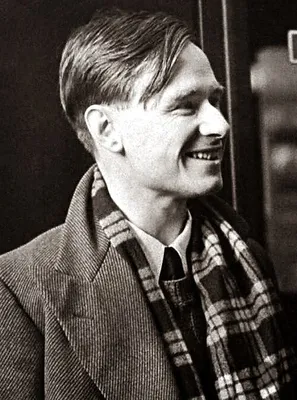
Christopher Isherwood
Christopher Isherwood was an English-American novelist and screenwriter known for his Berlin stories and later life in California.
Christopher Isherwood, born in England in 1904, became a notable novelist, playwright, screenwriter, autobiographer, and diarist, later becoming an American citizen. His early life included friendships with W.H. Auden and Edward Upward, and a brief, unsuccessful stint at Cambridge University. He worked as a private tutor and secretary before completing his first novel, "All the Conspirators," in 1928.
Isherwood's move to Berlin in 1929 proved pivotal, offering him the sexual freedom he sought and providing the backdrop for his most famous works, including "The Berlin Stories." These narratives captured the atmosphere of Weimar Germany as the Nazi party rose to power. He navigated complex personal relationships, including a lengthy relationship with Heinz Neddermeyer, which involved fleeing Nazi Germany and a prolonged period of separation. Isherwood also collaborated with Auden on several plays and traveled to China.
Relocating to the United States, Isherwood became a naturalized citizen in 1946. He lived in California, befriended prominent literary figures, and continued his writing career. His long-term relationship with Don Bachardy began in 1952, and he also taught literature. Isherwood passed away in 1986.
Early Literary Circles and Influences
Born in Cheshire, England, Christopher Isherwood's early education at St. Edmund's and Repton brought him into contact with significant literary figures who would become lifelong friends and collaborators. At St. Edmund's, he met W.H. Auden, and at Repton, he formed a close bond with Edward Upward. Together with Auden and Stephen Spender, they were recognized in the 1930s as a leading group of emerging writers, with Auden dubbing Isherwood the primary novelist. This association also linked him to the broader group known as the MacSpaunday Poets. Before his notable Berlin period, Isherwood completed his debut novel, "All the Conspirators," which explored familial power dynamics, and briefly studied medicine in London.
Berlin and the Weimar Experience
Isherwood's relocation to Berlin in 1929 marked a significant turning point, driven by his desire for the sexual liberation available in the Weimar Republic. This period profoundly influenced his writing, leading to works like "The Memorial" and the collection "The Berlin Stories." His novel "Goodbye to Berlin" depicted the city's vibrant yet precarious atmosphere amidst the growing threat of Nazism, drawing inspiration from his real-life encounters and observations. It was within this collection that he introduced the character Sally Bowles, based on Jean Ross. His experiences in Berlin also led to a complex relationship with Heinz Neddermeyer, which involved escaping Nazi Germany and a protracted period of separation and uncertainty.
American Life and Later Works
Following his time in Berlin and travels that included China with W.H. Auden, Isherwood emigrated to the United States, settling in California and becoming a naturalized citizen in 1946. He established himself in Hollywood, forging friendships with writers like Truman Capote and Dodie Smith. During this period, he began a significant and enduring relationship with Don Bachardy, which commenced in 1952 and lasted until Isherwood's death. He also contributed to academia by teaching modern English literature at Los Angeles State College. His later works, such as "A Single Man" and his memoir "Christopher and His Kind," continued to explore themes of identity and relationships, with the latter connecting him to the Gay Liberation movement.
Key Ideas
- Exploration of sexual freedom in Weimar Berlin
- Depiction of societal shifts and rising political tensions
- Themes of identity, self-determination, and personal relationships
- Intersection of personal life and broader social movements (e.g., Gay Liberation)
Notable Quotes
“To Christopher, Berlin meant Boys”
“Homosexual relationships can be and frequently are happy. Many men live together for years and share their lives and their work, just as heterosexuals do. This truth is particularly disturbing and shocking even to “liberal people,” because it cuts across the romantic, tragic notion of homosexual fate.”
Books by Christopher Isherwood
2 free public domain books · Read online or download