Christopher A. Colmo
Al-Farabi was a pivotal early Islamic philosopher, music theorist, and political thinker, shaping Neoplatonism and Aristotelianism.
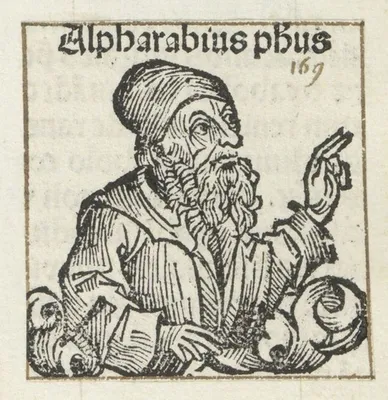
Abu Nasr Muhammad al-Farabi, known in the West as Alpharabius, was a highly influential philosopher and music theorist in the early Islamic world, active around the 10th century. He is recognized as a foundational figure in Islamic Neoplatonism and Islamic political philosophy, earning the title "Second Master" after Aristotle. Al-Farabi's intellectual pursuits spanned a wide range of subjects, including logic, language, psychology, epistemology, metaphysics, ethics, and political theory, alongside significant contributions to music theory and practical musicianship. His work integrated elements of Greek philosophy, particularly Plato and Aristotle, with Islamic thought, presenting a comprehensive philosophical system that extended beyond earlier traditions.
Details about Al-Farabi's life are scarce and often based on hearsay, with his exact origins and early life remaining subjects of scholarly debate. It is known that he spent a significant portion of his scholarly career in Baghdad, interacting with Syriac Christian scholars, and later resided in Damascus and Egypt. He died in Damascus between 950 and 951 CE. Despite the limited biographical information, his intellectual legacy is profound, influencing numerous subsequent philosophers across the Islamic and Western worlds.
Philosophical System and Influence
Al-Farabi is celebrated for constructing the first coherent philosophical system within the Islamic world, significantly developing upon the Neoplatonic and Aristotelian traditions inherited from Greco-Roman and Syriac sources. His original philosophical framework extended far beyond the scholastic interests of his predecessors. This intellectual achievement led later thinkers to refer to him as the "Second Master," positioning him just below Aristotle in philosophical stature. His influence was widespread, impacting prominent philosophers such as Avicenna, Averroes, Maimonides, and Albertus Magnus, demonstrating his reach across both Islamic and Latinate intellectual spheres.
Intellectual Scope and Contributions
The philosophical interests of Al-Farabi were exceptionally broad, encompassing the philosophy of society and religion, language and logic, psychology and epistemology, metaphysics, political philosophy, and ethics. Beyond these core philosophical areas, he was also an accomplished musician and music theorist. While not primarily a scientist, his scholarly work incorporated insights from astronomy, mathematics, cosmology, and physics. He is credited with significant advancements in logic, including categorizing it into distinct groups and exploring non-Aristotelian forms of inference, as well as discussing topics like future contingents and the relationship between logic and grammar.
Biographical Uncertainty and Origins
Information regarding Al-Farabi's origins and personal history is notably fragmented and often contradictory, suggesting that detailed accounts were not recorded during his lifetime. While some scholars suggest a Turkic background, more recent research points towards a Persian or Sogdian origin, supported by linguistic evidence in his works and historical accounts from medieval biographers like Ibn Abi Usaibia. He spent his most productive scholarly years in Baghdad, engaging with Syriac Christian intellectuals, before moving to Damascus and Egypt. He passed away in Damascus in the years 950–951 CE.
Key Ideas
- Founder of Islamic Political Philosophy
- Father of Islamic Neoplatonism
- Second Master (after Aristotle)
- Coherent philosophical system in the Islamic world
- Integration of Greek philosophy with Islamic thought
- Categorization of logic into distinct groups
Books by Christopher A. Colmo
0 free public domain books · Read online or download