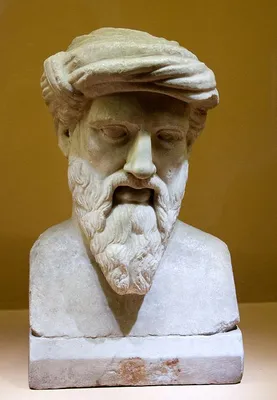
Christoph Riedweg
Pythagoras was an ancient Greek philosopher credited with founding Pythagoreanism and influencing Western thought, though details of his life and teachings are debated.
Pythagoras of Samos, an ancient Greek philosopher and founder of Pythagoreanism, is believed to have significantly influenced Plato and subsequent Western philosophy. While his exact education and influences are subjects of scholarly debate, it is generally agreed he established a secretive, ascetic school in Croton, southern Italy, around 530 BC. Ancient sources credit him with numerous mathematical and scientific discoveries, though many may have originated with his followers or predecessors. His most identifiable teaching is the transmigration of souls (metempsychosis), and he may have also proposed the concept of celestial harmony (musica universalis). His followers later clashed with democratic factions, leading to persecution and his possible death.
Authentic writings from Pythagoras himself are non-existent, and accounts of his life are largely derived from later biographies filled with myth and legend. Early biographical details are scarce, ambiguous, and sometimes satirical. While his birthdate is estimated around 570 BC, and he was the son of Mnesarchus from Samos, many other biographical elements are contested. It is plausible that his early life in Samos, a cultural hub, exposed him to diverse ideas. Scholarly consensus suggests he traveled extensively, with ancient traditions attributing his knowledge of metempsychosis to Egypt, Persia, or even India, though these accounts are often embellished. Similarly, claims of him studying under Greek thinkers like Thales or Orpheus, or receiving insights through dreams, are part of the legendary fabric surrounding him. However, his connection to Pherecydes of Syros, particularly regarding shared views on the soul and metempsychosis, is considered by some scholars to have a potential historical basis.
Core Teachings and Philosophical Influence
The central doctrine strongly associated with Pythagoras is the transmigration of souls, known as metempsychosis, which posits the immortality of the soul and its rebirth into new bodies. He may also have developed the theory of musica universalis, suggesting that celestial bodies move according to mathematical proportions, creating an inaudible cosmic symphony. These ideas, along with his broader philosophical framework, profoundly impacted later thinkers, most notably Plato, whose dialogues show clear Pythagorean influences. A significant resurgence of Pythagorean thought occurred in the first century BC, leading to Neopythagoreanism and continuing to shape philosophical and scientific inquiry through the Middle Ages and into the work of figures like Copernicus, Kepler, and Newton. His teachings also found expression in early modern European esotericism and contributed to the modern vegetarian movement.
The Enigmatic Figure of Pythagoras
Understanding Pythagoras's life and contributions is challenging due to the absence of original writings and the nature of surviving historical accounts. Early mentions by contemporaries like Heraclitus and Xenophanes are brief and often critical. The most extensive biographies, from Diogenes Laërtius, Porphyry, and Iamblichus, were written centuries later and are heavily laden with myths and fantastical embellishments that grow more elaborate with temporal distance. While these later sources sometimes incorporated material from earlier, more reliable 4th-century BC scholars like Dicaearchus and Aristoxenus, discerning factual information remains a complex task for modern historians. The contradictory nature of even basic biographical details underscores the legendary status Pythagoras achieved.
Alleged Travels and Influences
Ancient traditions widely depict Pythagoras as a traveler who acquired knowledge from diverse cultures. While modern scholarship acknowledges the influence of Levantine and Mesopotamian cultures on Archaic Greece, specific accounts of Pythagoras's journeys are often legendary. He is said to have learned metempsychosis from Egyptian priests, studied with Persian Magi or Zoroaster, and even gained knowledge from the Jews, Indians, Celts, and Iberians. Similarly, claims of him studying under Greek figures like Thales, Anaximander, or the mythical Orpheus, or receiving divine dictation, contribute to his mystical persona. Despite the fanciful nature of these narratives, some scholars, particularly regarding his connection with Pherecydes of Syros and shared views on the soul, suggest a potential kernel of historical truth in the idea of external influences shaping his thought.
Key Ideas
- Transmigration of souls (metempsychosis)
- Musica universalis (celestial harmony)
- Founding of Pythagoreanism
Books by Christoph Riedweg
2 free public domain books · Read online or download