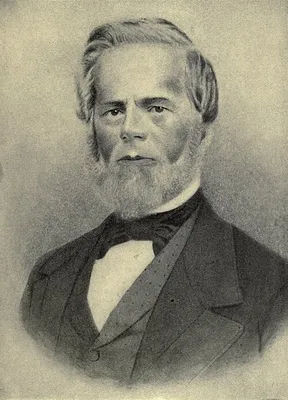
Charles Poyen
Phineas Quimby was an American folk healer and mesmerist whose ideas influenced the New Thought movement.
Phineas Parkhurst Quimby (1802–1866) was an American healer, mentalist, and mesmerist from Lebanon, New Hampshire. Despite limited formal education, he developed his own theories on healing after experiencing personal health issues. Quimby's work is widely considered foundational to the New Thought spiritual movement. He believed that diseases were rooted in false beliefs and that the cure lay in understanding and correcting these mental errors, rather than through physical medicine.
Quimby's engagement with mesmerism began around 1836, though he was skeptical of Charles Poyen's public lectures on the subject, deeming them a "humbug." He later found a collaborator in Lucius Burkmar, a young man susceptible to hypnosis, with whom he toured and demonstrated his healing practices. Quimby asserted that he did not prescribe medicine or apply external treatments, instead focusing on explaining the patient's condition to them. His approach involved sitting with patients, identifying their feelings and perceived ailments, and if the patient acknowledged his accuracy, his explanation served as the cure. He claimed that by correcting errors in belief, he could alter the body's state and restore health. His son, George, later defended his father's work and sought to distinguish it from that of Mary Baker Eddy, a notable patient who founded Christian Science.
Early Life and Developing Theories
Born in Lebanon, New Hampshire, Phineas Quimby received minimal formal schooling. As a youth, he suffered from what was then called consumption and was prescribed ineffective treatments. This personal experience led him to explore the connection between the mind and body, experimenting with methods that he believed alleviated his pain. He claimed to have cured himself of his illness through these self-developed techniques, sparking his interest in the power of mental states to influence physical well-being.
Mesmerism and Healing Practice
Quimby's involvement with mesmerism, also known as hypnotism, began around the time Charles Poyen, a French mesmerist, toured New England. However, Quimby expressed skepticism about Poyen's public demonstrations, calling them a "humbug." He later collaborated with Lucius Burkmar, a youth highly responsive to hypnotic suggestion, with whom he conducted public demonstrations. Quimby's healing practice centered on the belief that illness stemmed from erroneous beliefs. He would explain a patient's condition to them, and if the patient recognized the accuracy of his description, this explanation was considered the cure. He stated he offered no medicines or external applications, asserting that "The Truth is the Cure."
Beliefs and Influence
Quimby's philosophy posited that disease originated from false beliefs within the mind. His method of healing involved identifying these erroneous beliefs and correcting them through explanation, thereby restoring the patient to a state of health. While sometimes associated with Transcendentalism, his direct knowledge of its proponents was limited. His influence on the New Thought movement is significant, though the delayed publication of his writings meant his direct impact during the movement's early formation was indirect. Notable individuals who engaged with his ideas include Julius and Annetta Dresser, and Mary Baker Eddy, the founder of Christian Science, though significant differences exist between Quimby's teachings and Christian Science.
Key Ideas
- Disease is caused by false beliefs.
- The cure for disease lies in correcting these false beliefs through explanation.
- The mind has a powerful influence over the body's health.
- Truth, as understood through corrected beliefs, is the ultimate cure.
Notable Quotes
“Mesmerism was introduced into the U[nited] State[s] by M. Charles Poyen, a French gentleman, who did not appear to be highly blest with the powers of magnetising to the satisfaction of his audience in his public lectures. I had the pleasure of listening to one of his lectures, & pronounced it a humbug as a matter of course. And that his remarkable experiments, which were related, were, in my belief, equally true with witch craft—I had never been a convert to witch craft, nor had even had any personal interviews[?] with ghosts or hobgoblins & therefore considered all stories bordering on the marvelous as delusive—”
“Next came Dr Collyer, who perhaps did more to excite a spirit of enquirey throughout the community than any who have succeeded.”
“TO THE SICK... DR. P. P. QUIMBY would respectfully announce to the citizens of [blank space to be filled in] and vicinity, that he will be at the [blank space to be filled in] where he will attend to those wishing to consult him in regard to their health, and, as his practise is unlike all other medical practise, it is necessary to say that he gives no medicines and makes no outward applications, but simply sits down by the patients, tells them their feelings and what they think is their disease. If the patients admit that he tells them their feelings, &c., then his explanation is the cure; and, if he succeeds in correcting their error, he changes the fluids of the system and establishes the truth, or health. The Truth is the Cure. This mode of practise applies to all cases. If no explanation is given, no charge is made, for no effect is produced. His opinion without an explanation is useless, for it contains no knowledge, and would be like other medical opinions, worse than none. This error gives rise to all kinds of quackery, not only among regular physicians, but those whose aim is to deceive people by pretending to cure all diseases. The sick are anxious to get well, and they apply to these persons supposing them to be honest and friendly, whereas they are made to believe they are very sick and something must be done ere it is too late. Five or ten dollars is then paid, for the cure of some disease they never had, nor ever would have had but for the wrong impressions received from these quacks, or robbers, (as they might be called,) for it is the worst kind of robbery, tho' sanctioned by law. Now, if they will only look at the true secret of this description, they will find it is for their own selfish objects—to sell their medicines. Herein consists their shrewdness!—to impress patients with a wrong idea, namely—that they have some disease. This makes them nervous and creates in their minds a disease that otherwise would never have been thought of. Wherefore he says to such, never consult a quack: you not only lose your money, but your health. He gives no opinion, therefore you lose nothing. If patients feel pain they know it, and if he describes their pain he feels it, and in his explanation lies the cure. Patients, of course, have some opinion as to what causes pain—he has none, therefore the disagreement lies not in the pain, but in the cause of the pain. He has the advantage of patients, for it is very easy to convince them that he had no pain before he sat down by them. After this it becomes his duty to prove to them the cause of their trouble. This can only be explained to patients, for which explanation his charge is [blank space to be filled in] dollars. If necessary to see them more than once, [blank space to be filled in] dollars. This has been his mode of practice for the last seventeen years. For the past eight years he has given no medicines, nor made any outward applications. There are many who pretend to practice as he does, but when a person while in "a trance," claims any power from the spirits of the departed, and recommends any kind of medicine to be taken internally or applied externally beware! believe them not, "for by their fruits ye shall know them.”
Books by Charles Poyen
1 free public domain book · Read online or download