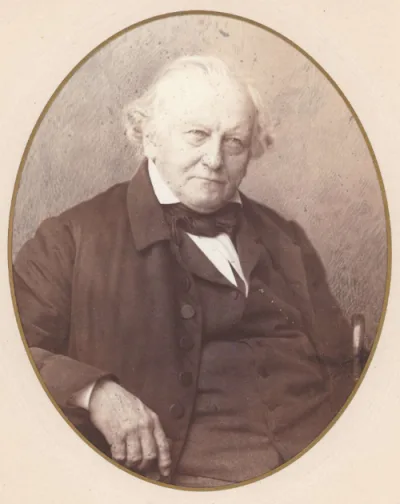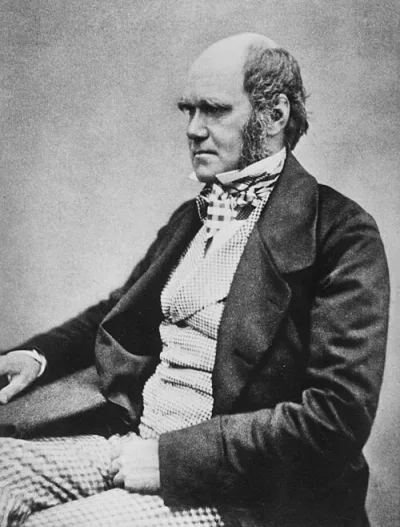
Charles Darwin
Charles Darwin proposed natural selection as the mechanism for evolution, fundamentally changing our understanding of life's diversity.
Charles Darwin, an English naturalist, geologist, and biologist, is renowned for his groundbreaking work on evolutionary biology. He posited that all life forms descend from a common ancestor, a concept now widely accepted as a cornerstone of science. Darwin, alongside Alfred Russel Wallace, developed the theory of evolution by natural selection, explaining how the struggle for existence drives species diversification, akin to artificial selection in breeding.
His formative years saw him neglecting medical studies for natural history, including work on marine invertebrates. A pivotal five-year voyage on HMS Beagle significantly advanced his geological understanding and provided crucial observations for his theories. Upon his return, Darwin meticulously investigated his findings, formulating his theory of natural selection by 1838. The publication of "On the Origin of Species" in 1859 presented compelling evidence for his evolutionary ideas, which eventually became the dominant scientific explanation for life's diversification.
Early Scientific Pursuits and Education
Born in 1809, Charles Darwin initially pursued medical studies at the University of Edinburgh but found them unengaging, preferring to assist with investigations into marine invertebrates. His passion for natural science flourished during his studies at Christ's College, Cambridge. While there, he developed an interest in entomology through his cousin and became a close associate of botany professor John Stevens Henslow. Darwin's early intellectual influences included William Paley's arguments for divine design and John Herschel's emphasis on inductive reasoning based on observation. Inspired by figures like Alexander von Humboldt, Darwin developed a strong desire to contribute to scientific understanding, even planning tropical expeditions.
The Transformative Voyage of HMS Beagle
Darwin's participation in the five-year survey voyage of HMS Beagle, beginning in 1831, proved to be a defining period for his scientific career. During this extensive journey charting the coast of South America, Darwin spent considerable time on land, diligently studying geology and collecting a vast array of natural history specimens. He meticulously documented his observations and developed theoretical ideas, sending his findings back to Cambridge. Despite severe seasickness, the voyage equipped him with the empirical data and geological insights that would later underpin his revolutionary theories on evolution and the Earth's history, supporting concepts of gradual geological change.
Formulating the Theory of Natural Selection
The geographical distribution of wildlife and fossils observed during the Beagle voyage spurred Darwin to undertake detailed investigations. By 1838, he had formulated his theory of natural selection. While he shared his ideas with fellow naturalists, extensive research was necessary for its full development. The simultaneous development of a similar concept by Alfred Russel Wallace led to a joint presentation of their theories in 1858. Darwin's subsequent publication of "On the Origin of Species" in 1859 provided substantial evidence for his theory of evolution, establishing it as the primary scientific explanation for the diversity of life.
Later Works and Lasting Impact
Following his seminal work on evolution, Darwin continued to explore related concepts in subsequent publications. He investigated coevolution in "Fertilisation of Orchids" (1862) and delved into human evolution and sexual selection in "The Descent of Man, and Selection in Relation to Sex" (1871). His work "The Expression of the Emotions in Man and Animals" (1872) is recognized as an early contribution to psychology and notably included photographs. Darwin's final book, "The Formation of Vegetable Mould, through the Actions of Worms" (1881), examined the role of earthworms in shaping the land. By the 1870s, his evolutionary ideas had gained significant acceptance within the scientific community and among the educated public, profoundly influencing the life sciences.
Key Ideas
- Evolutionary descent from a common ancestor
- Natural selection as the mechanism for evolution
- The struggle for existence driving species diversification
- Coevolution
- Human evolution and sexual selection
Books by Charles Darwin
6 free public domain books · Read online or download