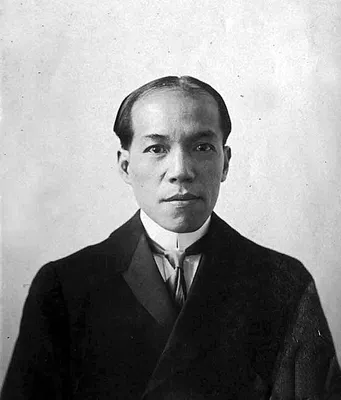
Chao Liang
Liang Qichao was a pivotal Chinese intellectual and activist who significantly influenced modern China's political and cultural reform.
Liang Qichao (1873-1929) was a prominent Chinese politician, activist, journalist, and intellectual whose ideas profoundly shaped modern China. A key figure in reform movements, he initially supported constitutional monarchy and worked alongside Kang Youwei. After the Hundred Days' Reform of 1898 was suppressed, Liang spent years in exile, primarily in Japan, where he continued to advocate for political change through his writings and by engaging with overseas Chinese communities and foreign governments. He also introduced Western and Japanese thought to China through translations, influencing a generation of scholars and activists. His political career included roles in the Beiyang government after the 1911 revolution, where he opposed Yuan Shikai's imperial ambitions and later served in financial capacities. Liang advocated for cultural change and modernization, emphasizing the transformation of people into citizens with improved civic ethos and exploring concepts of Chineseness as a cultural rather than purely ethnic identity. He also held views on racial classifications that influenced contemporary discourses on national strength.
Early Life and Education
Born in Guangdong Province in 1873, Liang Qichao displayed intellectual promise from a young age. His father, a farmer and scholar, fostered his education in classical literature. By age nine, Liang was writing complex essays and soon became a district-school student. He excelled in the traditional imperial examinations, passing the Xiucai degree at 11 and the Juren at 16, becoming the youngest candidate at that level. Despite failing the national Jinshi examination in Beijing in 1890, where he studied alongside Kang Youwei, Liang's intellectual journey was significantly shaped by his exposure to Western political thought, inspired by works like "Illustrated Treatise on the Maritime Kingdoms." He further pursued studies with Kang Youwei, whose teachings on foreign affairs deepened Liang's interest in reforming China.
Reform Movements and Exile
Liang Qichao became a fervent advocate for reform, collaborating with Kang Youwei on the "Hundred Days' Reform" in 1898, proposing institutional and ideological changes to the Guangxu Emperor. This reformist agenda was met with strong opposition from Empress Dowager Cixi, leading to its swift suppression and Liang being declared a wanted man. He fled to Japan, where he resided for 14 years. During his exile, Liang remained an active proponent of democratic causes, using his prolific writings to garner support for reformers among Chinese diaspora and international governments. He championed individualism and a constitutional monarchy, contrasting with more radical republican movements. His advocacy extended to supporting anticolonial revolutionaries like Vietnam's Phan Boi Chau and engaging with political figures in Canada, Australia, and the United States, exploring models for national integration and modernization.
Political Career and Ideological Contributions
Following the 1911 revolution, Liang Qichao transitioned into a more direct political role. He merged his party with Republicans to form the Progressive Party and critically engaged with the new government, notably opposing Yuan Shikai's ambition to become emperor. Liang's political thought was deeply influenced by Western ideas, which he accessed through Japanese translations. He focused on modernization, emphasizing the need to cultivate "civic ethos" among the Chinese populace and develop a strong sense of citizenship for nation-building. Liang viewed "Chineseness" as a cultural construct, believing that unifying diverse ethnicities into a single nation was crucial for China's strength, rather than focusing on ethnic Manchu rule. His writings on racial classifications also played a role in contemporary discussions about strengthening China.
Books by Chao Liang
1 free public domain book · Read online or download