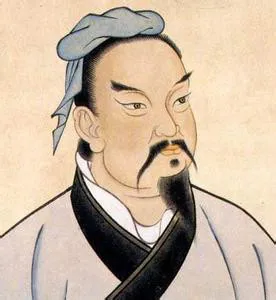
Changqing Guo
Sun Tzu, author of The Art of War, is a legendary figure whose historical existence and exact lifespan are debated by scholars.
Sun Tzu is traditionally recognized as a Chinese military general, strategist, philosopher, and writer from the Eastern Zhou period, credited with authoring The Art of War. However, his historical reality is uncertain, with some scholars suggesting the earliest parts of the text may date a century after his supposed lifetime. Traditional accounts, like those by Sima Qian, place him as a minister to King Helü of Wu, living from 544 to 496 BC. His popular name, Sun Tzu, is an honorific meaning "Master Sun," with his birth name possibly being Sun Wu and courtesy name Changqing.
Doubts about Sun Tzu's historical existence emerged as early as the 12th century, fueled by the absence of his mention in earlier historical texts like the Zuo Zhuan, which documented events and figures of the Spring and Autumn period. Furthermore, The Art of War contains anachronisms in terms, technology, and philosophical ideas that suggest a later composition, likely during the Warring States period. The 1972 discovery of texts at Yinque Shan, including parts of The Art of War and a work attributed to Sun Bin, a descendant, further complicated matters. This led to theories that Sun Bin might have been the actual author or that "Sun Tzu" represents a composite figure or an evolving intellectual tradition under the Sun name.
Historical Uncertainty and Authorship Debates
The historical existence of Sun Tzu is a subject of scholarly debate. While traditional accounts, notably from the Han dynasty historian Sima Qian, identify him as a minister to King Helü of Wu and place his life between 544–496 BC, later scholars have raised significant doubts. The absence of Sun Tzu's name in contemporary or earlier historical records, such as the Zuo Zhuan, despite his purported military achievements, has led many to question his historicity. The text attributed to him, The Art of War, contains elements and terminology that scholars believe are anachronistic for the Spring and Autumn period, suggesting a composition date closer to the Warring States period (475-221 BC). The rediscovery of Sun Bin's Military Methods alongside fragments of The Art of War in 1972 added another layer of complexity, prompting speculation that Sun Bin, a descendant, might have been the actual author or that "Sun Tzu" represents a lineage of military thought rather than a single individual.
The Art of War: Content and Philosophical Underpinnings
The Art of War, traditionally attributed to Sun Tzu, is a seminal Classical Chinese text comprising thirteen chapters that detail various aspects of military strategy and tactics. Beyond battlefield maneuvers, the work emphasizes the importance of diplomacy and maintaining relationships with other states for national well-being. A notable philosophical component is the incorporation of Taoist rhetoric, where warfare is sometimes used as a metaphor for persuasion and the "battle for hearts and minds." This Taoist influence is characterized by principles of parsimony, avoiding confrontation, and a preference for passive, silent approaches, aligning with broader Taoist tenets of frugality and spiritual nature. The text's enduring influence lies not only in its strategic advice but also in its philosophical depth, integrating practical warfare with broader ethical and metaphysical considerations.
Legacy and Influence
The Art of War has profoundly influenced military thought and strategy across East Asia and globally for centuries. It was a foundational text in Chinese military education, formalized as part of the Seven Military Classics by Emperor Shenzong of Song in 1080. Its principles have been studied and applied by countless generals and theorists, cementing its status as a masterpiece of strategic literature. The earliest known commentary was written by Cao Cao in the early 3rd century CE, who also edited the text. Later compilations, such as Ji Tianbao's in the 12th century, gathered multiple commentaries, further solidifying its academic and practical importance. The text's enduring legacy stems from its timeless insights into conflict, strategy, and the human condition, transcending its military origins to impact leadership and decision-making in various fields.
Key Ideas
- Military strategy and tactics
- Diplomacy and statecraft
- Taoist philosophy in warfare
- The importance of deception and planning
- The concept of 'winning without fighting'
Books by Changqing Guo
1 free public domain book · Read online or download