Carroll, Robert P; Prickett, Stephen
Lewis Carroll's "Jabberwocky" is a seminal nonsense poem, rich in invented words and open to diverse interpretations.
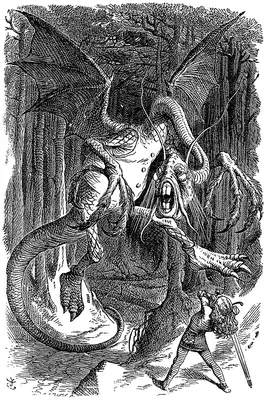
The nonsense poem "Jabberwocky," penned by Lewis Carroll, first appeared in his 1871 novel *Through the Looking-Glass*. The narrative features Alice discovering the poem written in mirror script, reflecting the book's topsy-turvy world. Considered a masterpiece of English nonsense verse, the poem is celebrated for its inventive language, contributing words like "galumphing" and "chortle" to the English lexicon. Carroll began writing the poem's initial stanza much earlier, around 1855, in a family periodical titled *Mischmasch*. The rest of the poem was composed later, potentially influenced by local legends and existing nonsense traditions. The poem's illustrations by John Tenniel are iconic and have been interpreted through the lens of Victorian scientific interests, such as paleontology. Carroll himself offered varying explanations for the poem's neologisms, often differing from character interpretations within the story, highlighting the inherent ambiguity and playful nature of his created lexicon.
Origins and Influences
Lewis Carroll's "Jabberwocky" originated with its first stanza, written in Croft-on-Tees and published in the family periodical *Mischmasch* around 1855 under the title "Stanza of Anglo-Saxon Poetry." The complete poem was later developed during his stay in Whitburn, possibly drawing inspiration from regional folklore like the Lambton Worm and the Sockburn Worm. Carroll was familiar with existing traditions of nonsense verse, found in chapbooks and established literature, including Shakespeare and the Brothers Grimm's tales. Some scholars suggest the poem might be a parody of German ballads or influenced by specific Shakespearean passages. John Tenniel's influential illustrations, created in 1871, have been analyzed as reflecting Victorian fascination with natural history and scientific discoveries, particularly paleontology, evident in the creature's depiction.
The Lexicon of Nonsense
A core feature of "Jabberwocky" is its extensive use of invented words, or nonce words, which Carroll created for playful effect rather than explicit meaning. The poem's character Alice finds the verse difficult to comprehend, a reaction that may mirror Carroll's intent for his readers, given the poem's dreamlike context. Carroll himself provided conflicting or ambiguous explanations for many of these words, sometimes differing from interpretations offered by characters like Humpty Dumpty within the narrative. For example, the creature "rath" is described variously as a badger, a pig, or a land turtle, with Carroll's own notes suggesting a badger-like creature. This deliberate linguistic ambiguity contributes to the poem's enigmatic quality, inviting diverse interpretations. Carroll also provided guidance on pronunciation for words like "slithy" and "rath" in later editions, emphasizing the intended sound and flexibility of his invented language.
Interpretations and Ambiguity
The fabricated words within "Jabberwocky," such as "bandersnatch," "borogove," and "frumious," are central to the poem's enduring appeal and scholarly discussion. Carroll's explanations for these terms, often provided in letters or prefaces, reveal a creative process blending existing words or concepts. For instance, "frumious" is described as a portmanteau of "fuming" and "furious," its pronunciation dependent on the speaker's mental inclination. The "Jabberwock" itself is interpreted by Carroll as potentially meaning "the result of much excited and voluble discussion," linking the word "jabber" with an Anglo-Saxon term for "offspring." The creature's visual representation, particularly in Tenniel's iconic illustration, fuses elements of known animals with fantastical traits, further contributing to its mysterious nature. The poem's open-ended lexicon and narrative allow for continuous reinterpretation, making it a rich subject for literary analysis.
Key Ideas
- Nonsense verse as a literary form
- Portmanteau words and neologisms
- Linguistic ambiguity and reader interpretation
- The interplay of text and illustration
- The dreamlike nature of narrative
Notable Quotes
“The new words, in the poem Jabberwocky, have given rise to some differences of opinion as to their pronunciation, so it may be well to give instructions on that point also. Pronounce 'slithy' as if it were the two words, 'sly, thee': make the 'g' hard in 'gyre' and 'gimble': and pronounce 'rath' to rhyme with 'bath'.”
“The Anglo-Saxon word 'wocer' or 'wocor' signifies 'offspring' or 'fruit'. Taking 'jabber' in its ordinary acceptation of 'excited and voluble discussion', this would give the meaning of 'the result of much excited and voluble discussion'...”
Books by Carroll, Robert P; Prickett, Stephen
0 free public domain books · Read online or download