Carrie De Voe
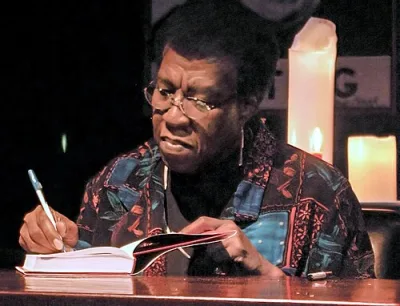
Octavia Butler was an award-winning American science fiction author known for her exploration of race, society, and humanity's future.
Octavia Butler, born in Pasadena, California, in 1947, became a highly acclaimed American science fiction and speculative fiction author. Despite a shy childhood and early struggles with dyslexia, she found solace and inspiration in books, beginning to write science fiction as a teenager. Her early life was marked by her upbringing with her widowed mother and grandmother in a strict Baptist environment, and she experienced the realities of racial segregation firsthand. Butler's writing career took off after attending the Clarion Workshop, leading to a prolific output of novels and short stories that earned her numerous awards, including Hugo, Locus, and Nebula awards. She was also the first science-fiction writer to receive a MacArthur Fellowship in 1995. Butler explored complex themes of race, power, gender, and survival, often incorporating elements that resonated with philosophical and societal critiques. She passed away in 2006 at the age of 58, leaving behind a significant literary legacy.
Early Life and Influences
Octavia Butler's childhood in Pasadena, California, was shaped by her role as an only child raised by her mother and grandmother. Her early years were characterized by extreme shyness and a difficult school experience, partly due to dyslexia. This led her to seek refuge in the local library, where she developed a passion for fantasy and science fiction. Inspired by authors and magazines of the era, she began writing her own stories at a young age, even acquiring a typewriter at ten. A pivotal moment occurred when she overheard a remark discouraging Black individuals from pursuing writing careers, which, instead of deterring her, solidified her resolve to become a writer. Her education included attending Pasadena City College, where her writing talents were recognized, and she began to formulate ideas for her future novels, including concepts that would later form the basis of her critically acclaimed work.
Literary Career and Thematic Exploration
Butler's professional writing journey began with her first published stories in the early 1970s, following her attendance at the Clarion Workshop. She gained recognition for her unique voice in science fiction, a field then dominated by white male authors. Her early works, such as the Patternist series, explored complex societal structures and human evolution, often featuring telepathic abilities and psionic chains. Later novels like 'Kindred' delved into historical trauma and the African American experience through time travel. Butler's writing consistently addressed themes of race, identity, power dynamics, and survival, often placing marginalized characters in challenging speculative scenarios. Her ability to weave these profound social commentaries into compelling narratives earned her widespread critical acclaim and numerous prestigious awards, solidifying her status as a pioneering figure in science fiction.
Recognition and Later Life
Throughout her career, Octavia Butler's contributions to literature were recognized with significant accolades. She received multiple Hugo, Locus, and Nebula Awards for her groundbreaking novels and short stories. A major milestone was her selection as the first science-fiction author to receive a MacArthur Fellowship in 1995, a testament to the intellectual and artistic merit of her work. This fellowship provided her with financial security, allowing her to focus more intensely on her writing. After her mother's passing, Butler relocated to Washington state. Despite facing personal challenges and evolving creative impulses, she continued to write, producing works like the 'Parable' series, which offered prescient social commentary. Her final novel, 'Fledgling,' was published shortly before her death in 2006 from a stroke at the age of 58. Her extensive literary papers are preserved at the Huntington Library.
Key Ideas
- Exploration of race and identity in speculative fiction
- Themes of power dynamics and societal control
- Human survival and adaptation in challenging futures
- Critique of social inequalities and historical trauma
Books by Carrie De Voe
1 free public domain book · Read online or download