Caroline Walker Bynum
Affective piety involved intense emotional devotion to Jesus' humanity, particularly his suffering, and Mary's sorrows.
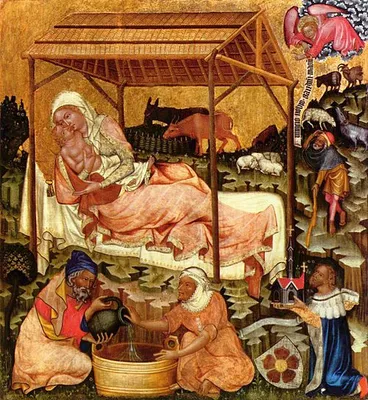
Affective piety, a significant devotional style in late-medieval Europe, emphasized a deeply emotional connection to the human aspects of Jesus, especially his infancy and suffering, and the sorrows of the Virgin Mary. This practice often involved prayer, reading, and meditation, frequently utilizing vivid imagery derived from biblical scenes, saints' lives, or religious symbols. Devotees were encouraged to visualize these scenes as if present, stimulating strong feelings of love, grief, or repentance. While the subject matter varied, depictions of Christ's Passion and Crucifixion, often graphically violent, were particularly prominent. This form of piety was cultivated through both written texts and visual art, such as manuscript illuminations and altarpieces, aiming to evoke a visceral emotional response in the practitioner. Figures like Margery Kempe exemplified this intense, imaginative engagement with religious narratives.
Scholarly consensus, often referred to as the "Southern Thesis," traces the origins of affective piety to the High Middle Ages, particularly the eleventh and twelfth centuries. Key figures like Anselm of Canterbury and Bernard of Clairvaux are credited with shaping this devotional shift through their writings, which emphasized introspection, emotional tenderness, and a compassionate focus on Christ's human sufferings. This development is linked to theological shifts, such as the move from the "Devil's Rights" theory of atonement to the Satisfaction Theory, which allowed for a greater appreciation of Christ's sacrifice. The Cistercians played a crucial role in popularizing this literature, and later, figures like St. Francis and his followers brought these devotional practices to a wider audience.
Origins and Development of Affective Piety
The development of affective piety is often linked to a shift in devotional practices beginning in the eleventh and twelfth centuries. Richard W. Southern's work highlights an "urge towards a greater measure of solitude, of introspection, and self-knowledge" that spread throughout Europe, leading to an "outburst of meditations and spiritual soliloquies." Anselm of Canterbury is considered a foundational figure, characterized by "ardent and effusive self-disclosure" and a passionate focus on the details of Christ's sufferings. His prayers are described as opening "a new world of ardent emotion and piety" by emphasizing the humanity of the Savior. This shift is connected to a revised understanding of atonement, moving from the "Devil's Rights" theory to the Satisfaction Theory, which underscored Christ's role as a substitute for humanity and enabled a "fresh appreciation of the human sufferings of the Redeemer."
The Role of Key Figures and Institutions
Following Anselm, Bernard of Clairvaux and the Cistercians further developed affective piety. Bernard refined the practice of "imaginative following of the details of the earthly life of Jesus, and especially of the sufferings of the Cross," integrating it into a spiritual progression. Later, St. Francis of Assisi and his followers disseminated these devotional experiences, making them accessible to both laypeople and clergy. This tradition continued to evolve, with the "somewhat hectic piety of the fourteenth and fifteenth centuries" seen as a result of the weakening of the intellectual framework that initially supported the surge of devotion in earlier centuries. The Cistercians, along with figures like Aelred of Rievaulx, were instrumental in shaping and disseminating this style of intense, emotional engagement with religious themes.
Characteristics and Expressions of Affective Piety
Affective piety is characterized by a profound emotional engagement with religious subjects, particularly the human suffering of Christ and the sorrows of the Virgin Mary. Devotional literature and art of this period often employed vivid and graphic imagery to stir these emotions. Examples include intense descriptions of the Passion and Crucifixion, designed to evoke feelings of love, grief, and repentance. This practice involved meditation, prayer, and reading, often enhanced by visualization techniques. Individuals were encouraged to imagine themselves present at biblical events, leading to strong emotional responses, such as weeping and sobbing, as exemplified by Margery Kempe. Visual aids, from manuscript illuminations to altarpieces like the Isenheim Altarpiece, served as focal points for this deeply personal and emotionally charged spiritual practice.
Key Ideas
- Intense emotional devotion to the humanity of Jesus and the Virgin Mary.
- Use of vivid imagery and visualization in prayer and meditation.
- Focus on the Passion and Crucifixion of Christ, often with graphic depictions.
- Emphasis on introspection, emotional tenderness, and compassionate engagement with religious suffering.
- Connection to theological shifts in understanding atonement.
Notable Quotes
“Ah, Lord, your sorrow—why was it not my death? Now they lead you forth as naked as a worm, with torturers around you and armed knights. The press of the crowd was incredibly intense as they threw things and harried you so shamefully, kicking at you as if you had been a dog. I see in my soul how ruefully you walk, your body so bloody, so raw and blistered. The crown on your head is so sharp, and your hair, blown in the wind, is all matted with blood. Your lovely face is so pale and swollen with the blows and the beatings, and covered with spittle and phlegm. And down runs your blood; it horrifies me to see it.”
“Sche had many an holy thowt of owr Lordys passyon and beheld hym in hir gostly syght as verily as he had ben aforn hir in hir bodily syght. Therfor myth sche not wythstondyn wepyng and sobbyng, but sche must nedys wepyn, cryin, and sobbyn whan sche beheld hir Savyowr suffyr so gret peynys for hir lofe.”
“The Passion of the Lord signifies our time, in which we now weep. Whips, fetters, mockings, spit, crown of thorns, embittered wine, vinegar in a sponge, insults, taunts, finally the cross itself, the holy limbs hanging on the wood, what does this signify to us, if not the time in which we act, the time of mourning, the time of mortality, the time of temptation?”
Books by Caroline Walker Bynum
2 free public domain books · Read online or download