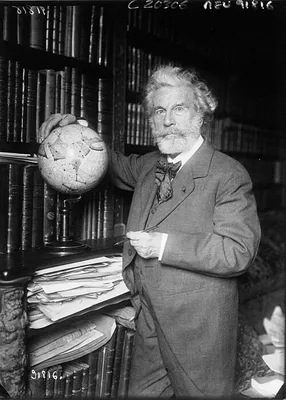
Camille Flammarion
Camille Flammarion was a French astronomer and author known for his popular science works, early science fiction, and extensive writings on psychical research and spiritualism.
Nicolas Camille Flammarion (1842–1925) was a French astronomer and prolific author who also delved deeply into psychical research, spiritualism, and early science fiction. He authored over fifty titles, popularizing astronomy while also exploring concepts like life after death, extraterrestrial civilizations, and reincarnation. Flammarion maintained a private observatory and founded the French Astronomical Society. His work often blended scientific speculation with spiritualist beliefs, influenced by thinkers like Jean Reynaud and the rising popularity of spiritism in his era. He approached psychical research with a scientific mindset, though he also attended séances and claimed some phenomena were genuine, despite acknowledging the unreliability of mediums.
Flammarion's interest in life beyond Earth led him to speculate about Martian inhabitants and the potential dangers of Halley's Comet, though his more sensational beliefs were often amplified by the press. His writings on the transmigration of souls and the evolution of the human spirit across planets formed a unique synthesis of science, religion, and speculative fiction. He believed that souls progressed through successive incarnations on different worlds, a concept that permeated both his non-fiction and his science fiction narratives. Despite his belief in the survival of the soul, he was skeptical of the spirit hypothesis in Spiritism, instead proposing an unknown "psychic force" as an explanation for phenomena like ectoplasm and levitation.
Astronomy and Popular Science
Camille Flammarion was a renowned French astronomer and a prolific writer, publishing over fifty books. He dedicated himself to making astronomy accessible to the public through his popular science works. In addition to his writing, he established and led the French Astronomical Society, serving as its first president. Flammarion also maintained his own private observatory in Juvisy-sur-Orge, France, where he conducted his astronomical observations. He was instrumental in popularizing astronomical discoveries and theories of his time, fostering a broad public interest in the cosmos.
Spiritualism and Psychical Research
Deeply influenced by the spiritualist movements of his time, Flammarion dedicated significant effort to the study of psychical phenomena, reincarnation, and life after death. He approached these subjects with a declared commitment to the scientific method, emphasizing impartial analysis over religious dogma. He maintained close ties with Allan Kardec, the founder of Spiritism. While Flammarion believed in the survival of the soul and attended séances, he was critical of mediums, noting their frequent dishonesty. He investigated phenomena such as levitation and alleged spirit manifestations, often seeking explanations in unknown "psychic forces" or telepathy rather than purely spiritualistic interpretations.
Science Fiction and Philosophical Ideas
Flammarion's literary output included notable early science fiction novels that often intertwined with his philosophical and spiritual beliefs. He was particularly fascinated by the possibility of life on other planets and the concept of the transmigration of souls. Influenced by Jean Reynaud, Flammarion envisioned souls progressing through successive incarnations on various worlds, viewing humanity as "citizens of the sky." His fictional works explored these ideas, depicting sentient plants, interstellar travel, and the evolutionary journeys of souls across the universe, blending scientific speculation with his conviction in a cosmic spiritual evolution.
Beliefs on Extraterrestrial Life and Comets
Flammarion was a strong proponent of the plurality of inhabited worlds. He speculated about intelligent beings on Mars, interpreting the observed "canals" as artificial constructions by a dying civilization. He also engaged with the public's fears surrounding celestial events, notably Halley's Comet in 1910. While he correctly assessed the minimal danger posed by the comet's tail, sensationalist media widely misrepresented his views, falsely reporting him as predicting an apocalyptic event. This highlights his role in shaping public perception of scientific and astronomical matters, sometimes inadvertently.
Key Ideas
- Transmigration of souls across planets
- Progressive spiritual evolution through reincarnation
- Scientific investigation of psychical phenomena
- Possibility of extraterrestrial life and intelligence
- Skepticism towards spirit hypothesis in Spiritism, favoring "psychic force"
Notable Quotes
“It is by the scientific method alone that we may make progress in the search for truth. Religious belief must not take the place of impartial analysis. We must be constantly on our guard against illusions.”
“It is infinitely to be regretted that we cannot trust the loyalty of mediums. They almost always cheat”
“This is very far from being demonstrated. The innumerable observations which I have collected during more than forty years all prove to me the contrary. No satisfactory identification has been made. The communications obtained have always seemed to proceed from the mentality of the group, or when they are heterogeneous, from spirits of an incomprehensible nature. The being evoked soon vanishes when one insists on pushing him to the wall and having the heart out of his mystery. That souls survive the destruction of t”
Books by Camille Flammarion
2 free public domain books · Read online or download