C. H. van Schooneveld
The Flying Dutchman is a legendary ghost ship, originating from 17th-century Dutch maritime lore, often seen as an omen of doom.
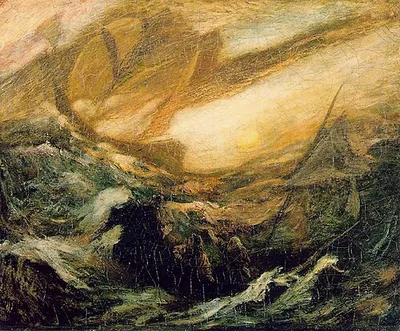
The Flying Dutchman is a mythical ghost ship, perpetually sailing the seas and unable to reach port. Its legend likely emerged during the Dutch Golden Age of maritime power in the 17th century, with the earliest known accounts dating to the late 18th century. Sailors believed sighting the spectral vessel, often described as glowing with a ghostly light, foretold disaster. The ship was commonly thought to be a 17th-century Dutch fluyt, a type of cargo vessel.
Early literary references depict the ship as a lost vessel appearing in stormy weather. Later accounts introduced themes of punishment for past transgressions, with some suggesting the crew committed a dreadful crime or piracy, leading to their eternal damnation. One version attributes the curse to the captain, Hendrick van der Decken, who swore he would round the Cape of Good Hope even if it took until the day of judgment. Reported sightings continued into the 19th and 20th centuries, adding to the legend's mystique. Scientific explanations often attribute these sightings to optical illusions like mirages or looming effects.
Origins and Early Depictions
The legend of the Flying Dutchman appears to have roots in the maritime activities of the 17th-century Dutch East India Company. The earliest known written mention comes from John MacDonald's "Travels" in 1790, describing a ghost ship seen in stormy weather near the Cape. George Barrington's "A Voyage to Botany Bay" (1795) offers a more detailed account, suggesting the story spread among sailors after a Dutch man-of-war was lost. John Leyden's "Scenes of Infancy" (1803) introduced the motif of punishment for a crime, with the crew doomed to eternal penance. Thomas Moore's poem in 1804 further popularized the tale, placing the ship in the North Atlantic. Sir Walter Scott's notes for "Rokeby" (1812) were among the first to label the ship as pirate-related, though he also noted a variation suggesting the crime involved the first transport of enslaved people from Africa.
The Captain and the Curse
A prominent figure in the legend is the captain, often identified as Hendrick van der Decken. According to a story published in Blackwood's Edinburgh Magazine in 1821, Van der Decken was a 17th-century Amsterdam captain. While attempting to round the Cape of Good Hope, he encountered adverse winds and swore a blasphemous oath to continue sailing until the day of judgment if necessary. This curse bound him and his crew to sail the seas eternally. The legend states that the Flying Dutchman appears only during storms and serves as a harbinger of doom. The ship is said to glow with an unearthly light, and its spectral crew might attempt to send messages to land or to the deceased if hailed by another vessel.
Reported Sightings and Explanations
Numerous alleged sightings of the Flying Dutchman have been reported across the 19th and 20th centuries. A notable account comes from the log of Prince George of Wales (later King George V), who, along with his brother and tutor, claimed to have witnessed the spectral ship off the coast of Australia in 1881. They described a phantom vessel glowing with a strange red light. The legend also inspired later writers, such as Nicholas Monsarrat. Scientifically, the phenomenon is often explained as a superior mirage or a Fata Morgana, an optical illusion caused by atmospheric conditions that can make distant objects appear distorted or elevated in the air. Another optical effect, looming, can also make a ship just beyond the horizon seem to be suspended above the water.
Key Ideas
- Ghost ship doomed to sail eternally
- Portent of doom and misfortune
- Originates from 17th-century Dutch maritime lore
- Captain's curse leading to eternal damnation
- Optical illusions as potential explanation
Notable Quotes
“The weather was so stormy that the sailors said they saw the Flying Dutchman. The common story is that this Dutchman came to the Cape in distress of weather and wanted to get into harbour but could not get a pilot to conduct her and was lost and that ever since in very bad weather her vision appears.”
“I had often heard of the superstition of sailors respecting apparitions and doom, but had never given much credit to the report; it seems that some years since a Dutch man-of-war was lost off the Cape of Good Hope, and every soul on board perished; her consort weathered the gale, and arrived soon after at the Cape. Having refitted, and returning to Europe, they were assailed by a violent tempest nearly in the same latitude. In the night watch some of the people saw, or imagined they saw, a vessel standing for them under a press of sail, as though she would run them down: one in particular affirmed it was the ship that had foundered in the former gale, and that it must certainly be her, or the apparition of her; but on its clearing up, the object, a dark thick cloud, disappeared. Nothing could do away the idea of this phenomenon on the minds of the sailors; and, on their relating the circumstances when they arrived in port, the story spread like wild-fire, and the supposed phantom was called the Flying Dutchman. From the Dutch the English seamen got the infatuation, and there are very few Indiamen, but what has some one on board, who pretends to have seen the apparition.”
“It is a common superstition of mariners, that, in the high southern latitudes on the coast of Africa, hurricanes are frequently ushered in by the appearance of a spectre-ship, denominated the Flying Dutchman ... The crew of this vessel are supposed to have been guilty of some dreadful crime, in the infancy of navigation; and to have been stricken with pestilence ... and are ordained still to traverse the ocean on which they perished, till the period of their penance expire.”
“Fast gliding along, a gloomy bark / Her sails are full, though the wind is still, / And there blows not a breath her sails to fill.”
“The above lines were suggested by a superstition very common among sailors, who call this ghost-ship, I think, 'the flying Dutch-man'.”
Books by C. H. van Schooneveld
0 free public domain books · Read online or download