Byron L. Sherwin
Esterka, a legendary Jewish mistress of Casimir III the Great, influenced Polish Jewish history and culture.
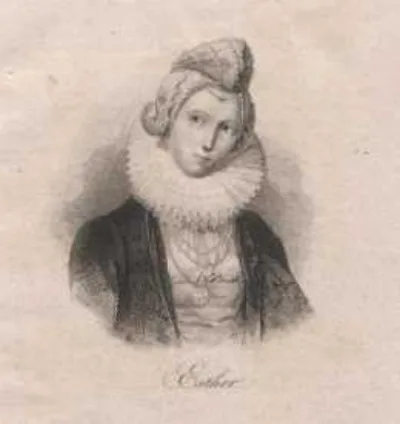
Esterka, also known as Estera, is the name given to a Jewish woman who, according to later accounts and folklore, was the mistress of Casimir III the Great, King of Poland from 1333 to 1370. Medieval Polish and Jewish writers often treated their romance as historical fact, portraying her as a beautiful Jewish woman who held significant influence over the king.
Legend attributes Esterka with considerable intelligence and beauty, suggesting she was the daughter of a poor tailor. She is said to have been installed in the royal palace and served as an advisor to Casimir, supporting policies like free trade, urban development, religious tolerance, and cultural advancement. Her influence is credited with helping to protect Polish Jews during the Black Death. Despite Casimir having other wives, Esterka is said to have borne him two sons, Pelko and Nemir, and two daughters. Her sons were reportedly baptized and became mythical ancestors of Polish noble families, while her daughters were raised as Jews. The legend concludes with Esterka and her daughters being murdered during anti-Jewish riots following Casimir's death.
Historical and Legendary Accounts
The earliest accounts of Esterka appear in the writings of the 15th-century chronicler Jan Długosz and later in the work of the Jewish chronicler David Gans in the 16th century. Gans even suggested Esterka was married to King Casimir, describing her as exceptionally beautiful and his wife for many years. He stated that Casimir extended numerous privileges to Jews in his kingdom due to her influence, citing her role in issuing documents of freedom and beneficence. According to these legends, Esterka was the daughter of a tailor and possessed remarkable beauty and intellect. She was reportedly housed in the royal palace at Łobzów near Krakow.
Influence and Legacy
Esterka's legendary role extended to advising King Casimir on matters of state. She is depicted as a supporter of free trade, the construction of stone cities, tolerance towards different religious groups, and the promotion of cultural development. Her influence is credited with reinforcing Casimir's generally favorable stance towards the Jewish population, contributing to Krakow becoming a major center for European Jewry. During the devastating period of the Black Death, Esterka's intercession is said to have prevented pogroms against Polish Jews who were wrongly blamed for the epidemic. Her sons, Pelko and Nemir, are presented in the legend as having been baptized at their father's request, becoming progenitors of several Polish noble houses. Pelko was sent to Krakow to foster relations between Jewish, Polish, and German communities, while Nemir was dispatched to Ruthenia to establish a knightly order.
End of the Legend
The legend recounts that after Casimir the Great's death and the ascension of his nephew Louis of Hungary to the Polish throne, anti-Jewish sentiment intensified, leading to riots. According to the narrative, Esterka's palace in Łobzów was attacked by rioters, resulting in her death and the murder of her two daughters. A burial site near the Rudawa River, associated with the Rudanovsky family, is considered by some to be Esterka's final resting place. The narrative highlights the precarious position of Jews even under supposedly tolerant rulers, and the potential for violence to erupt during periods of political transition.
Cultural and Geographical Impact
The figure of Esterka has left a lasting imprint on Polish culture and geography. Numerous places, including villages, streets, and monuments, have been named in her honor, often in locations associated with her and King Casimir. Some historical accounts suggest Esterka may have lived with the King at Wawel Castle. The Royal Palace in Łobzów, originally a defensive fort, is also legendarily linked to Casimir's construction for Esterka. A mound near the Rudawa River, known as Esterka Mound, was excavated in the late 18th century in the hope of finding her grave, though it was later destroyed. Esterka continues to be a subject in modern art, literature, and music, appearing in murals, chronicles, novels, and musical compositions, underscoring her enduring presence in historical and cultural narratives.
Key Ideas
- The legendary influence of a Jewish mistress on a Polish king's policies and treatment of Jews.
- The role of folklore in shaping historical narratives and cultural memory.
- The historical significance of Jewish communities in medieval Poland.
- The impact of royal patronage and personal relationships on religious and cultural tolerance.
- The representation of historical figures in art, literature, and music.
Notable Quotes
“"Casimir, the king of Poland, took for himself a concubine - a young Jewess named Esther. Of all the maidens of the land, none compared to her beauty. She was his wife for many years. For her sake, the king extended many privileges to the Jews of his kingdom. She persuaded the king to issue documents of freedom and beneficence."”
Books by Byron L. Sherwin
0 free public domain books · Read online or download