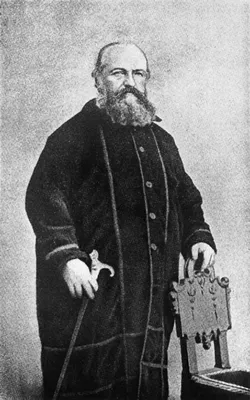
By Eliphas Levi
Eliphas Lévi was a 19th-century French occultist, writer, and ceremonial magician who significantly influenced Western esotericism.
Alphonse Louis Constant, who adopted the pen name Eliphas Lévi, was a French writer and occultist born in 1810. After an early ecclesiastical path in the Catholic Church, he left the priesthood and became deeply involved in ceremonial magic and the study of the occult. Lévi authored over 20 books exploring subjects such as magic, Kabbalah, alchemy, and occultism, gaining recognition among esotericists and artists in Paris and London.
He developed a unique perspective on magic, incorporating elements of Kabbalah, Tarot, and symbolism. Lévi's work emphasized the importance of willpower and understanding universal forces, diverging from Spiritualism by positing that post-mortem consciousness consisted of mental images and "astral forces" manipulable by skilled practitioners. He also offered explanations for phenomena like table-turning, attributing them to natural magnetic currents. His writings, though sometimes obscure, were presented without overt fanaticism and without personal gain, aiming to impart knowledge for the betterment of humanity.
Lévi's influence extended to prominent esoteric organizations and figures, including the Hermetic Order of the Golden Dawn and Aleister Crowley. He also established symbolic interpretations, such as the meaning of the pentagram's orientation, and contributed to the integration of Tarot into Western magical practices. His ideas impacted figures like Helena Blavatsky and the Theosophical Society, cementing his legacy as a pivotal figure in the history of Western esotericism.
Early Life and Occult Development
Born Alphonse Louis Constant in Paris, Lévi initially pursued a career within the Catholic Church, entering the seminary of Saint Sulpice. Although he was ordained a deacon, he ultimately left the path to priesthood just before his ordination. This departure, which caused him significant personal difficulty and led him to wear clerical attire for years, was attributed to "strange views on doctrinal subjects" or "doubts and scruples." He experienced periods of poverty, working as a tutor and briefly entering monastic life before quitting. His early writings, including "La Bible de la liberté," led to imprisonment. Around the age of 40, after experiencing financial and spiritual crises, Lévi became more deeply immersed in the mid-19th-century esoteric milieu.
Magical Philosophy and Writings
Lévi's extensive literary output, numbering over 20 books, delved into magic, Kabbalah, alchemy, and occultism. His work, particularly "Dogme et Rituel de la Haute Magie," attracted attention for its original thinking. He viewed magic as a science and art, emphasizing the power of will and the understanding of universal forces. Lévi incorporated symbols, particularly from Kabbalah and Tarot, into his magical system, making the Tarot a significant element in Western magical practices. He also proposed symbolic meanings for the pentagram, distinguishing between its representation of good and evil based on its orientation.
Influence and Legacy
Eliphas Lévi's ideas had a profound impact on subsequent generations of occultists and esoteric movements. He influenced the Hermetic Order of the Golden Dawn and prominent figures like Aleister Crowley and Helena Blavatsky. Lévi also developed a critical stance towards Spiritualism, which was gaining popularity, arguing that post-mortem phenomena involved "astral forces" rather than autonomous spirits, and that these forces could be manipulated by adept magicians. He explained purported supernatural events as manifestations of natural magnetic currents. Despite the complexity of his teachings, Lévi presented himself as a scholar offering knowledge freely for the benefit of humanity, without claiming initiation into secret societies.
Key Ideas
- Magic as a science and art based on willpower and universal forces.
- The incorporation of Kabbalah and Tarot into Western magical systems.
- Symbolic interpretation of the pentagram (one point up for good, one point down for evil).
- Post-mortem consciousness as manipulable astral forces, distinct from Spiritualist concepts of spirits.
- Explanation of spiritualist phenomena as natural magnetic currents.
Notable Quotes
“I ceased being a freemason, at once, because the Freemasons, excommunicated by the Pope, did not believe in tolerating Catholicism ... [and] the essence of Freemasonry is the tolerance of all beliefs.”
“He [Levi] seems, however, to have conceived strange views on doctrinal subjects, though no particulars are forthcoming, and, being deficient in gifts of silence, the displeasure of authority was marked by various checks, ending finally in his expulsion from the Seminary. Such is one story at least, but an alternative says more simply that he relinquished the sacerdotal career in consequence of doubts and scruples.”
“I had undertaken a journey to London, that I might escape from internal disquietude and devote myself, without interruption, to science. [...] They asked me forthwith to work wonders, as if I were a charlatan, and I was somewhat discouraged, for, to speak frankly, far from being inclined to initiate others into the mysteries of Ceremonial Magic, I had shrunk all along from its illusions and weariness. Moreover, such ceremonies necessitated an equipment which would be expensive and hard to collect. I buried myself therefore in the study of the transcendent Kabbalah, and troubled no further about English a”
“The phenomena which quite recently have perturbed America and Europe, those of table-turning and fluidic manifestations, are simply magnetic currents at the beginning of their formation, appeals on the part of Nature inviting us, for the good of humanity, to reconstitute great sympathetic and religious chains.”
“A poor and obscure scholar [who] has found the lever of Archimedes, and he offers it to you for the good of humanity alone, asking nothing whatsoever in exchange.”
Books by By Eliphas Levi
1 free public domain book · Read online or download