Bruce Privratsky
Bruce Privratsky is an author whose work focuses on the history and evolution of Islam in Kazakhstan and Central Asia.
Bruce Privratsky's writings explore the historical trajectory of Islam in Kazakhstan, detailing its introduction in the 8th century and its gradual expansion across the Kazakh Steppe. The religion's spread was influenced by key events like the Battle of Talas and the efforts of spiritual leaders such as Khoja Ahmad Yasawi. During the Golden Horde period, Islam became the official religion under Özbeg Khan, with subsequent rulers continuing Islamic traditions.
The Russian Imperial era saw a complex relationship, with initial tolerance and state support for Islamic institutions, including mosque and madrasa construction, alongside attempts to integrate Kazakhs into a Russian-influenced Islamic framework. This period also witnessed resistance from Sufi leaders. The Soviet era brought severe persecution, with systematic closure and destruction of mosques and suppression of religious figures, though Islam persisted in some communities and experienced a shift in policy during World War II to mobilize support. Despite state control, spiritual leaders found ways to accommodate and maintain their roles within communities.
Introduction and Early Spread of Islam
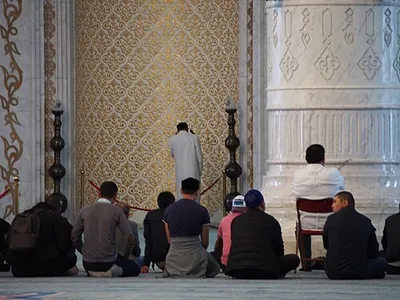
Islam became the dominant religion in Kazakhstan, with a significant majority of the population identifying as Muslim. Historically, Islam arrived in the southern regions of modern-day Kazakhstan during the 8th century with the expansion of Arab influence. Its spread across the vast Kazakh Steppe was a gradual process over subsequent centuries. A pivotal moment contributing to its dissemination was the Battle of Talas in 751 AD, where local nomadic groups allied with the Abbasid Arabs against the Chinese Tang dynasty. Following this, Islam gained a stronger foothold in the southern parts of Turkestan and subsequently moved northward. The influence of Samanid rulers also played a role in conversions, particularly in areas around Taraz.
Medieval and Golden Horde Influence
The 11th century saw a significant impact on the spread of Islam through the work of Khoja Ahmad Yasawi, a prominent Turkic poet and Sufi leader. He played a crucial role in disseminating Islamic teachings among both settled and nomadic populations of Central Asia by composing works in the Middle Turkic language, earning him recognition as a major spiritual figure. Centuries later, Timur honored him by constructing a mausoleum in his name. By the first half of the 14th century, the Dasht-i Qipchaq region was predominantly Muslim, with Kazakhs considering Islam their ancestral faith. During the Golden Horde era, Berke Khan was the first ruler to convert, though he did not actively promote it. However, in 1321, Özbeg Khan officially adopted Islam, making it the state religion and encouraging its adoption among his subordinates, initiating a tradition of khans adopting Islamic names.
Russian Imperial and Soviet Eras
During the 18th century, Russian influence grew, initially allowing Islam to develop. Empress Catherine II supported the construction of mosques and madrasas, establishing the Orenburg Muslim Spiritual Assembly to foster loyalty to the Russian state. This period also saw an Islamic revival among Kazakhs, partly driven by merchants and Volga-Ural clerics. However, resistance from Sufi leaders against Russian expansion was documented. Russian policy later shifted towards weakening Islam by promoting pre-Islamic traditions. The Soviet era brought severe persecution, with systematic closure of mosques and suppression of religious figures and institutions. Despite this, everyday Muslim practices persisted, and a controlled form of Islam was later permitted during World War II to garner support, leading to a complex coexistence of Islamic identity with Soviet patriotism.
Books by Bruce Privratsky
1 free public domain book · Read online or download