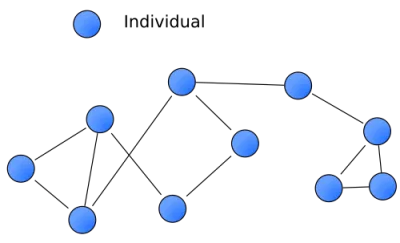
Anthropologist Bruce Kapferer introduced the concept of multiplex ties, relationships with multiple overlapping contexts.
Bruce Kapferer, an anthropologist, contributed to the study of social networks with his concept of multiplex ties. These are relationships characterized by the overlap of various roles, exchanges, or affiliations between individuals. Kapferer's work, stemming from field research in Africa, was published in 1969 under the title "Norms and the Manipulation of Relationships in a Work Context".
This idea of multiplexity draws an analogy from telecommunications, where a multiplexer allows a single transmission medium to carry multiple signals. In social relations, it signifies a similar layering of connections within a single interpersonal bond. Kapferer's research explored how these multifaceted relationships function within social structures, particularly in work environments. His contribution offers a nuanced perspective on the complexity of human connections beyond simple dyadic relationships.
Multiplex Ties in Social Networks
Bruce Kapferer's significant contribution to social network analysis is his concept of "multiplex ties." Introduced in his 1969 publication, "Norms and the Manipulation of Relationships in a Work Context," this idea emerged from his anthropological fieldwork conducted in Africa. Kapferer proposed that relationships are not always singular in nature but can be characterized by multiple, overlapping contexts. This means that two individuals might be connected through various roles, exchanges, or affiliations simultaneously. The term "multiplexity" itself is borrowed from telecommunications, where a device called a multiplexer enables a single communication channel to transmit multiple distinct signals. By extension, in social interactions, multiplexity refers to the intricate layering of connections that can exist within a single relationship, adding depth and complexity to social structures.
Context and Relationship Complexity
Kapferer's postulation of multiplex ties suggests that the strength and nature of a relationship can be understood by examining the various dimensions through which individuals interact. Instead of viewing a tie as a simple connection, multiplexity acknowledges that a relationship can encompass professional connections, personal friendships, familial obligations, or transactional exchanges all at once. This multi-layered approach provides a more realistic model for understanding the dynamics within social groups, particularly in contexts like work environments, where individuals often navigate a complex web of interwoven relationships. His research highlights that understanding these overlapping contexts is crucial for comprehending how relationships are managed and how social norms operate within specific social settings.
Key Ideas
- Multiplex ties: Relationships characterized by multiple overlapping contexts, roles, exchanges, or affiliations.
Books by
3 free public domain books · Read online or download