British Acupuncture Council.
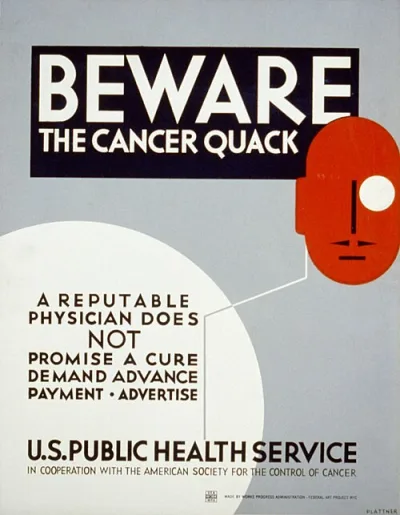
Quackery involves promoting fraudulent or ignorant medical practices, often with aggressive marketing and questionable treatments.
Quackery refers to the promotion of medical practices that are fraudulent, ignorant, or lack scientific support. The term originates from the Dutch word 'kwakzalver,' meaning 'hawker of salve,' and historically described those who loudly advertised unproven remedies. Modern definitions encompass the overpromotion of health-related products and services, regardless of the promoter's intent. Key issues include the use of questionable diagnoses and treatments, especially for serious illnesses, and the potential for individuals to forgo effective conventional therapies in favor of ineffective ones.
Historically, unproven and sometimes dangerous medicines were widely marketed, often with theatrical displays and exaggerated claims. While some historical remedies contained ingredients that offered symptomatic relief or had limited medicinal effects (like opium or willow bark), knowledge of proper use and dosage was often lacking. The promotion of patent medicines, particularly in Britain and its colonies during the 17th and 18th centuries, utilized branding and mass marketing. Despite efforts by medical organizations to expose these practices, such as the British Medical Association's 1909 publication 'Secret Remedies,' quackery persisted due to the difficulty in defining legitimate medicine and the appeal it held for consumers.
Definition and Characteristics of Quackery
Quackery is broadly defined as the promotion of fraudulent or ignorant medical practices. A key characteristic is aggressive marketing, often involving questionable diagnoses, unproven treatments, and unsubstantiated claims, particularly for serious diseases. Psychiatrist Stephen Barrett defines it as the promotion of methods lacking a scientifically plausible rationale or anything involving overpromotion in the health field. This can include questionable ideas, products, and services, irrespective of the promoter's sincerity. The term 'fraud' is typically reserved for cases involving deliberate deception. Quackery poses risks by potentially leading individuals to abandon effective conventional treatments in favor of ineffective ones.
Historical Context and Evolution of Quackery
The practice of peddling unproven and sometimes dangerous medicines has a long history. In the 17th and 18th centuries, patent medicines, often containing alcohol or opium, gained prominence through mass marketing and branding, providing symptomatic relief rather than cures. These products, originating largely in Britain, were exported widely. By the mid-19th century, remedies like revalenta arabica, despite grand claims, were merely ordinary ingredients sold at inflated prices. While some historical remedies contained ingredients with medicinal properties, such as mercury or quinine, knowledge of their proper use and dosage was limited. Efforts to combat quackery, like the British Medical Association's 'Secret Remedies' in 1909, aimed to expose the contents and costs of these potions, though some survived for decades.
Challenges in Identifying and Regulating Quackery
Distinguishing between those who knowingly promote unproven therapies and those who are genuinely mistaken about their effectiveness presents a significant challenge. Courts have sometimes ruled that accusing someone of quackery is not equivalent to accusing them of medical fraud, acknowledging this difficulty. However, regulatory bodies like the FDA may make little distinction. The appeal of quackery often lies in its ability to offer hope or perceived simplicity, and its persistence is partly due to the difficulty in definitively separating it from legitimate medical practice and its appeal to consumers seeking alternatives or perceived cures.
Key Ideas
- Quackery involves the promotion of unproven or fraudulent medical practices.
- Aggressive marketing and questionable claims are common characteristics.
- Historical quack remedies often contained ineffective or misleading ingredients.
- The distinction between genuine belief and deliberate deception can be difficult.
- Consumers may be drawn to quackery, leading them to forgo effective treatments.
Books by British Acupuncture Council.
1 free public domain book · Read online or download