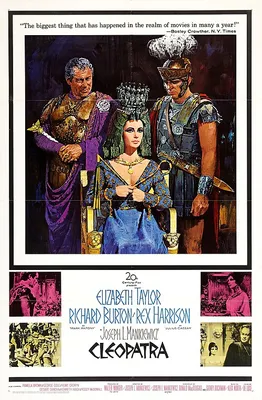
Brad Geagley
Brad Geagley is an author whose Wikipedia entry details the production of the 1963 film Cleopatra.
The Wikipedia entry for Brad Geagley focuses on the complex and costly production of the 1963 epic historical drama film, Cleopatra. Directed by Joseph L. Mankiewicz, the film was adapted from Carlo Maria Franzero's book and historical accounts by Plutarch, Suetonius, and Appian. Elizabeth Taylor starred in the title role, undertaking the part for a significant salary. The production was plagued by delays, budget overruns, and a change in directors, with Mankiewicz taking over from Rouben Mamoulian. Filming took place across multiple locations, including Pinewood Studios and Cinecittà, and was further complicated by a widely publicized affair between stars Elizabeth Taylor and Richard Burton. The film's immense budget made it the most expensive ever produced at the time, nearly bankrupting Twentieth Century Fox.
The narrative of the film chronicles the political and romantic entanglements of Cleopatra VII of Egypt as she navigates the imperial ambitions of Rome, particularly with Julius Caesar and later Mark Antony. The plot details her efforts to maintain her throne, her relationships with these Roman leaders, the birth of her son Caesarion, and the eventual conflict with Octavian. The story culminates in the Battle of Actium, Antony and Cleopatra's defeat, and their suicides, followed by Egypt's absorption into the Roman Empire. Despite its financial challenges and mixed critical reception, Cleopatra achieved significant box office success in 1963 and garnered multiple Academy Award wins.
Production Challenges and Scale
The creation of the 1963 film Cleopatra was an undertaking of immense scale and significant difficulty. Producer Walter Wanger harbored a long-held ambition to bring Cleopatra's story to the screen, finding his ideal vision for the role in Elizabeth Taylor after seeing her in "A Place in the Sun." The project eventually partnered with Twentieth Century Fox, a studio then facing financial difficulties and seeking a major success. The film's development involved extensive script revisions by multiple writers and a substantial financial commitment, with Taylor commanding a record-setting salary. Principal photography commenced in 1960 but was immediately hampered by Taylor's health issues, leading to significant delays and budget overruns. Production was halted and later relocated, with Joseph L. Mankiewicz replacing the initial director, Rouben Mamoulian. The film's ambitious scope and numerous setbacks ultimately contributed to its status as the most expensive film made up to that point.
Narrative and Historical Scope
The film's plot traces the life of Cleopatra VII, Queen of Egypt, focusing on her strategic alliances and romantic relationships with Roman leaders Julius Caesar and Mark Antony. It depicts her struggles to maintain Egyptian independence against Rome's expanding power. The narrative details her initial alliance with Caesar, the birth of their son Caesarion, and the political ramifications of these connections within Rome. Following Caesar's assassination, the story shifts to Cleopatra's involvement with Mark Antony, their passionate affair, and their eventual confrontation with Octavian. The film culminates in the decisive naval Battle of Actium, the defeat of Antony and Cleopatra's forces, and their tragic suicides, marking the end of Ptolemaic Egypt and its incorporation into the Roman Empire.
Artistic and Critical Reception
Upon its release in 1963, Cleopatra garnered a generally positive reception from American film critics, though it was met with less enthusiasm in Europe. Despite its critical reception, the film achieved considerable commercial success, becoming the highest-grossing film of 1963 and one of the decade's top earners worldwide. However, its massive production and marketing costs, totaling approximately $44 million, meant the film initially incurred a substantial financial loss for the studio. The film's artistic achievements were recognized at the 36th Academy Awards, where it received nine nominations and secured four wins: Best Art Direction (Color), Best Cinematography (Color), Best Visual Effects, and Best Costume Design (Color), highlighting its visual splendor and technical craft.
Books by Brad Geagley
1 free public domain book · Read online or download