Boris Mouravieff
Boris Mouravieff was a Russian historian and philosopher known for his work on Eastern Orthodox esoteric tradition.
Boris Mouravieff (1890-1966) was a Russian historian, philosopher, and writer. Born into a prominent naval family, he served as an officer in the Imperial Russian Navy, even commanding a flotilla he helped design. He held positions in the Russian Provisional Government before leaving military service after the 1917 revolution. Following periods in Constantinople and Bulgaria, Mouravieff settled in France in 1924. He worked as a consulting engineer while pursuing historical research and his deep interest in the esoteric traditions of Eastern Orthodoxy. His research was influenced by his great-uncle, a founder of an Orthodox monastery on Mount Athos, who had explored similar traditions.
Mouravieff later moved to Switzerland, where he faced financial hardship but continued his academic and spiritual pursuits. He earned a degree in international studies and began to systematically document his knowledge of esoteric Christianity. This led to his influential three-volume work, "Gnosis: Study and Commentaries on the Esoteric Tradition of Eastern Orthodoxy." He also taught esoteric philosophy at the University of Geneva and established the Centre for Esoteric Christian Studies (C.E.C.E.) to foster the development of a "New Man" and practical study groups. His later writings, "The Stromata," aimed to provide practical guidance to complement his "Gnosis" teachings.
Early Life and Naval Career
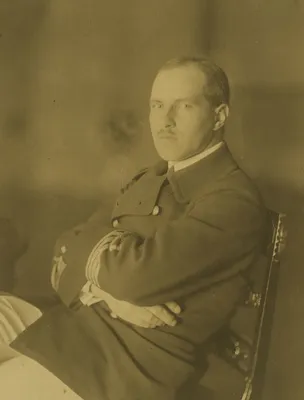
Born Boris Petrovich Mouravieff in Kronstadt, Russia, on March 8, 1890, he hailed from a distinguished family with military and state service backgrounds. He pursued a career in the navy, graduating from the Imperial Russian Naval Academy. Mouravieff served aboard the historic cruiser Aurora and later commanded a flotilla of torpedo boats, which he had helped design. His naval career progressed to the rank of lieutenant commander and then frigate captain. He briefly served in the Russian Provisional Government before leaving the military in 1918 to focus on business, archaeology, and esoteric and historical research.
Exile and Esoteric Pursuits
After leaving Russia around 1920, Mouravieff spent time in Constantinople and Bulgaria before settling in France in 1924. During his time in Constantinople, he attended lectures by P. D. Ouspensky and connected with G. I. Gurdjieff, with whom he maintained contact over the years. Mouravieff developed a close working relationship with Ouspensky, collaborating on his work. From his youth, Mouravieff was deeply interested in the esoteric dimension of Eastern Orthodoxy, influenced by his great-uncle, a figure associated with Mount Athos who had researched ancient traditions. This lifelong interest formed the core of his later intellectual and spiritual work.
Academic Career and "Gnosis"
In Switzerland, where he relocated in 1944 as a refugee, Mouravieff eventually secured a position as a privat-docent at the University of Geneva. He taught courses on Russian history and, significantly, on esoteric philosophy, focusing on the esoteric tradition of Eastern Orthodoxy. These lectures formed the foundation for his magnum opus, the three-volume "Gnosis: Study and Commentaries on the Esoteric Tradition of Eastern Orthodoxy," published between 1961 and 1965. The work received critical acclaim, earning the Victor-Émile Michelet esoteric literature prize. Mouravieff also established the Centre for Esoteric Christian Studies (C.E.C.E.) in Geneva to promote the concept of the "New Man" and facilitate practical study groups.
Later Years and Legacy
Mouravieff retired from the University of Geneva in 1962 to dedicate himself fully to the C.E.C.E. and his writing. He aimed to elaborate on the teachings presented in "Gnosis" through a series of writings called "The Stromata," intended to provide practical guidance. These writings were designed to address questions arising from the study of his doctrine. His intense work schedule took a toll on his health, leading to a heart attack in 1965. Boris Mouravieff passed away in Geneva on September 28, 1966. The C.E.C.E. ceased operations after his death. His archives were later entrusted to the Public and University Library of Geneva.
Key Ideas
- Esoteric Tradition of Eastern Orthodoxy
- The concept of the "New Man"
- The "Transition period" in history
- Practical application of esoteric doctrine
Books by Boris Mouravieff
1 free public domain book · Read online or download