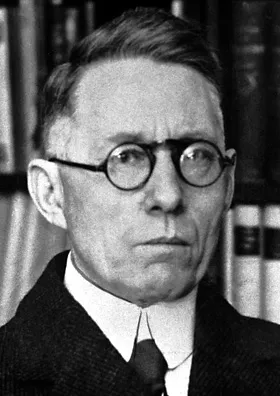
Bo Jensen
Danish author Johannes V. Jensen was awarded the 1944 Nobel Prize in Literature for his prolific and creatively styled literary achievements.
Johannes V. Jensen, a Danish author, received the 1944 Nobel Prize in Literature, recognized for his 'rare strength and fertility of his poetic imagination' combined with intellectual curiosity and a fresh, creative style. He was the fourth Dane to receive this prestigious award. Jensen's literary career began with works reflecting fin-de-siècle pessimism, but he soon developed his unique voice. His notable contributions include the 'Himmerland Stories,' a series set in his native region, and the historical novel 'The Fall of the King,' which explored 16th-century Danish history. Jensen's magnum opus is considered to be the six-volume novel series 'The Long Journey,' detailing humanity's early history through an evolutionary lens. Beyond novels, he was also a prolific poet and essayist, with his 1906 poetry collection 'Poems' marking the beginning of Danish modernist poetry. Jensen was a frequent nominee for the Nobel Prize, having been nominated 53 times since 1925, including every year from 1931 to 1944.
Literary Evolution and Major Works
Johannes V. Jensen's early literary output was characterized by the prevailing pessimism of the fin-de-siècle era. However, he soon forged his distinct literary identity, notably through his "Himmerland Stories," a collection of tales rooted in the Danish region of his birth, published between 1898 and 1910. This was followed by "The Fall of the King," a significant historical novel focusing on the life of the 16th-century Danish monarch Christian II, released in two parts between 1900 and 1901. Jensen's most ambitious undertaking is widely regarded as the six-volume epic "The Long Journey," published between 1908 and 1922. This monumental work chronicles the broad sweep of early human history, integrating themes of evolutionary theory.
Poetic Innovation and Broader Contributions
Beyond his narrative fiction, Jensen was also a significant poet and essayist. His collection "Poems," published in 1906, is considered a foundational text for modernist poetry in Denmark, signaling a departure from traditional forms and themes. His literary output extended to numerous other prose works and essays, showcasing a diverse range of interests and styles. The Nobel committee cited his 'rare strength and fertility of his poetic imagination,' coupled with a broad 'intellectual curiosity' and a 'bold, freshly creative style,' as key reasons for his award. This recognition underscored his multifaceted talent and his impact on Danish literature.
Nobel Prize Recognition and Nomination History
Johannes V. Jensen's path to the Nobel Prize in Literature was marked by extensive recognition from nominators over many years. He received nominations on 53 separate occasions, beginning in 1925, and was consistently nominated annually from 1931 through 1944. The Nobel committee received a significant number of nominations for him in the years leading up to the award, including seven in 1942. Despite some internal opposition within the Swedish Academy, particularly from committee chair Per Hallström who found Jensen's modernist style 'repulsive,' other members like Anders Österling and Sigfrid Siwertz championed his work. Ultimately, Jensen secured the 1944 prize, with the award ceremony taking place in Stockholm on December 10, 1945, due to wartime circumstances.
Notable Quotes
“for the rare strength and fertility of his poetic imagination with which is combined an intellectual curiosity of wide scope and a bold, freshly creative style.”
“repulsive”
“brutal”
Books by Bo Jensen
1 free public domain book · Read online or download