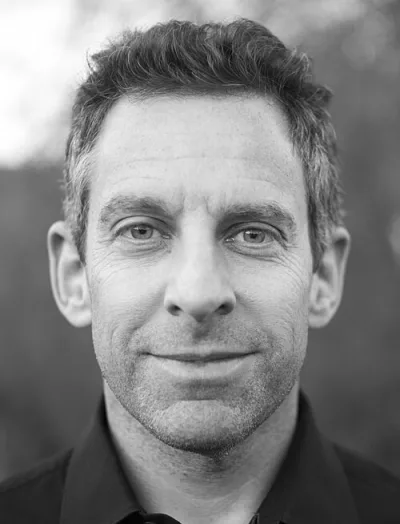
Sam Harris is a neuroscientist and philosopher known for his critiques of religion, advocacy for secularism, and exploration of consciousness.
Samuel Benjamin Harris, born in 1967, is an American neuroscientist, philosopher, author, and podcast host whose work spans topics such as rationality, ethics, neuroscience, and spirituality. He gained significant attention for his critiques of organized religion and is recognized as one of the "Four Horsemen" of New Atheism. His initial academic pursuits at Stanford led him to explore philosophical questions, particularly after an experience with MDMA, which sparked an interest in achieving spiritual insights without substances. This led him to travel to India and Nepal, where he studied meditation with Buddhist and Hindu teachers. He later returned to Stanford, earned a philosophy degree, and pursued a Ph.D. in cognitive neuroscience from UCLA, focusing his research on the neural basis of belief.
Harris's writing often delves into the intersection of science and human values, challenging religious dogma and advocating for a secular approach to morality. His notable works include "The End of Faith" (2004), which became a bestseller, and "Waking Up: A Guide to Spirituality Without Religion" (2014). He also hosts the "Making Sense" podcast, where he discusses a wide range of subjects with various experts, and has developed a meditation app. While a critic of many religious traditions, he acknowledges potential insights from Eastern contemplative practices, emphasizing their secular applicability.
Philosophical and Scientific Inquiry
Sam Harris's intellectual journey began with an interest in philosophy, significantly influenced by an experience with MDMA during his time at Stanford University. This event prompted him to explore the possibility of attaining spiritual insights through non-pharmacological means. His subsequent travels to India and Nepal led him to engage with Buddhist and Hindu meditation traditions under various teachers. This period also saw him briefly serve as a volunteer guard for the Dalai Lama. Returning to academia, he completed a degree in philosophy before earning a Ph.D. in cognitive neuroscience from UCLA. His doctoral research utilized fMRI to investigate the neurological underpinnings of belief and uncertainty, with his thesis titled "The Moral Landscape: How Science Could Determine Human Values."
Critique of Religion and New Atheism
Harris is a prominent figure in the New Atheist movement, known for his sharp critiques of organized religion, particularly its dogmatic aspects. He argues that religious claims often represent a "betrayal of science" and advocates for a rational approach to understanding the world. While critical of religion in general, he has differentiated between various faiths, sometimes highlighting the non-violent tenets of Jainism as a contrast to what he perceives as more dangerous aspects of other religions. His work often challenges the notion that all religions are morally equivalent, suggesting that their doctrines and scriptures can lead to vastly different societal impacts. He has engaged in numerous public debates on religious and philosophical topics with prominent figures.
Exploration of Consciousness and Spirituality
Beyond his critiques of religion, Harris has actively explored the nature of consciousness and secular spirituality. His book "Waking Up: A Guide to Spirituality Without Religion" and the accompanying meditation app aim to provide a framework for cultivating mindfulness and understanding the mind without recourse to supernatural beliefs. He draws inspiration from Eastern contemplative practices, such as those found in Buddhism and Hinduism, emphasizing their potential to foster well-being and ethical behavior. Harris promotes the idea that profound insights into the nature of reality and the self can be accessed through disciplined meditation and introspection, making these practices accessible to individuals regardless of their religious or non-religious affiliations.
Key Ideas
- Critique of religious dogma and advocacy for secular rationality.
- Exploration of consciousness and secular spirituality through meditation.
- The potential for science to inform human values and ethics.
- Neuroscience of belief, disbelief, and uncertainty.
Books by
2 free public domain books · Read online or download