Bihar School of Yoga.
The Yoga Sutras of Patañjali is an ancient Indian text compiled from various sources, outlining the practice and philosophy of yoga.
The Yoga Sutras of Patañjali is a foundational Sanskrit text on yoga, compiled in India in the early centuries CE. It is understood to be a compilation from diverse sources, including Samkhya philosophy, Buddhist traditions, and older ascetic speculations. While traditionally attributed solely to the sage Patañjali, scholarly analysis suggests that parts, particularly the fourth chapter, might be a later addition. The text is often viewed as a unified work with its commentary, the Yogabhashya, also traditionally attributed to Patañjali, though sometimes linked to Vyasa or Vindhyavasin.
The work is structured into aphorisms (sutras) that detail the path to yoga, focusing on concepts like one-pointed awareness and liberation (kaivalya). It is particularly known for its description of Ashtanga Yoga, an eight-limbed path comprising yama, niyama, asana, pranayama, pratyahara, dharana, dhyana, and samadhi. Despite its current prominence, historical research indicates the Yoga Sutras experienced periods of relative obscurity before regaining significant influence in the late 19th and 20th centuries.
Origins and Compilation
The Yoga Sutras of Patañjali is not an original creation but a compilation drawn from a variety of earlier traditions. Scholars suggest it integrates elements from Samkhya philosophy, Buddhist thought, and various older ascetic and religious speculations, dating from the 2nd century BCE to the 1st century CE. Patanjali is credited with organizing this knowledge into a coherent text, though some theories propose a later compiler may have added the fourth chapter. The text's structure and content reflect this composite origin, leading to observations of both apparent lack of unity and an underlying focus on core yogic principles.
Philosophical Framework
The Yoga Sutras builds upon the Samkhya concepts of purusha (consciousness) and prakriti (matter/nature), often seen as complementary. It incorporates Buddhist terminology and ideas, particularly concerning altered states of awareness and the cessation of mental fluctuations (vritti nirodha). The text's primary focus is on achieving "one-pointed awareness" and "content-free awareness" (nirvikalpa samadhi) through practices like Kriya Yoga and Ashtanga Yoga. The ultimate goal described is kaivalya, or liberation, understood as the discernment of pure consciousness (purusha) as distinct from the material world and cognitive processes (prakriti).
The Eight Limbs of Yoga (Ashtanga Yoga)
The Yoga Sutras is most recognized for its detailed exposition of Ashtanga Yoga, an eight-limbed path designed to lead to yogic absorption (samadhi). These eight limbs are: yama (ethical restraints), niyama (observances), asana (postures), pranayama (breath control), pratyahara (withdrawal of the senses), dharana (concentration), dhyana (meditation), and samadhi (absorption). The culmination of this path is the stilling of the mind, which allows for the realization of the self as pure consciousness, separate from the material world.
Authorship and Dating Debates
The authorship and precise dating of the Yoga Sutras remain subjects of academic discussion. While manuscripts attribute the work to Patanjali, some scholars argue that the fourth chapter is a later addition. The identity of Patanjali himself is debated, as another figure of the same name authored a major Sanskrit grammar text, though linguistic and stylistic differences suggest they may be separate individuals. Scholarly consensus on dating ranges widely, with many placing the text around the turn of the Common Era (1st-2nd century CE), while others propose dates as late as the 4th or 5th century CE, though these later dates face challenges.
Textual Integrity and Commentary
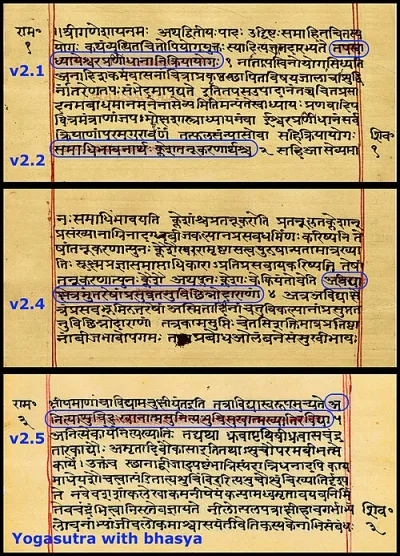
Scholars now widely believe that the Yoga Sutras and its primary commentary, the Yogabhashya, were originally intended as a single, integrated work, often referred to as the Pātañjalayogaśāstra. This practice of authoring aphorisms with an accompanying explanation was common at the time. While traditionally attributed to the sage Vyasa, modern research suggests Patañjali himself authored the commentary to clarify his terse sutras. The Yogabhashya is considered essential for understanding the sutras, though its attribution has also been debated, with some linking it to Vindhyavasin.
Key Ideas
- Ashtanga Yoga (eight-limbed path)
- Kaivalya (liberation)
- Purusha (consciousness)
- Prakriti (nature/matter)
- Vritti Nirodha (cessation of mental fluctuations)
- Ekagrata (one-pointed awareness)
- Nirvikalpa Samadhi (content-free awareness)
Books by Bihar School of Yoga.
1 free public domain book · Read online or download