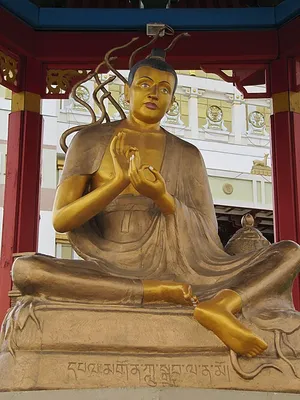
Bhikshu Dharmamitra
Madhyamaka, founded by Nāgārjuna, is a Buddhist philosophy emphasizing emptiness of inherent existence.
Madhyamaka, meaning 'middle way,' is a school of Buddhist philosophy established by the Indian monk Nāgārjuna. Its core tenet is that all phenomena are 'empty' (śūnya) of inherent existence or self-nature (svabhāva), meaning they lack an independent, substantial essence. This emptiness, however, is not a void or a separate reality, but rather a description of how things exist dependently.
The philosophy profoundly influenced Mahāyāna Buddhism, particularly in Tibetan and East Asian traditions. Madhyamaka thinkers used rigorous reasoning, often employing a four-cornered negation (catuṣkoṭi), to deconstruct essentialist views. They argued that concepts like causality and change are incompatible with the idea of inherent nature. While acknowledging conventional reality, Madhyamaka posits that ultimate reality is characterized by this lack of intrinsic, independent existence. The practice involves a cognitive shift to perceive phenomena as they truly are, devoid of superimposed essences.
The Middle Path and Emptiness
Madhyamaka, originating from the Sanskrit term 'madhyamaka' meaning 'middling' or 'middle way,' is a philosophical tradition founded by Nāgārjuna. It advocates for a 'middle path' that avoids extreme metaphysical views, such as eternalism and annihilationism. The central concept is 'emptiness' (śūnyatā), which asserts that all phenomena, or 'dharmas,' lack 'svabhāva'—an inherent essence, substance, or independent existence. This emptiness is not a nihilistic void but a description of phenomena arising dependently, without any self-sufficient nature. Even emptiness itself is considered empty, not pointing to a transcendental realm but to the nature of phenomenal reality.
Refutation of Inherent Existence
A key Madhyamaka method involves refuting the concept of 'svabhāva,' which can be understood as identity, causal independence, essence, or substance. Madhyamaka thinkers use logical arguments, including the 'catuṣkoṭi' (four corners), to demonstrate that phenomena cannot possess inherent existence. They argue that anything arising dependently cannot have an intrinsic nature. If nothing has inherent nature, then nothing can have an 'other-nature' dependent on something with inherent nature. Consequently, there can be no truly existent or non-existent entities in an ultimate sense. This critique extends to causality itself, suggesting that objective causal relations are also conceptually constructed and lack independent existence.
Cognitive and Practical Dimensions
Beyond intellectual refutation, Madhyamaka addresses the cognitive dimension of how beings perceive reality. The notion of 'svabhāva' is seen as a cognitive distortion, a superimposition on phenomena rather than an objective characteristic. Understanding Madhyamaka reasoning alone is insufficient; a practical realization or cognitive shift is necessary to overcome suffering caused by this reification of the world. This involves seeing phenomena not as solid, independent entities but as dependently arisen and conceptually constructed. Nāgārjuna's work, particularly the 'Mūlamadhyamakakārikā,' employs reductio ad absurdum arguments to dismantle essentialist claims and highlight the emptiness of all conditioned phenomena.
Key Ideas
- Madhyamaka: Buddhist philosophy emphasizing the 'middle way'.
- Śūnyatā: The emptiness of inherent existence in all phenomena.
- Svabhāva: The concept of inherent nature or independent existence, which Madhyamaka refutes.
- Dependent Arising: The doctrine that all phenomena arise in dependence on conditions.
- Catuṣkoṭi: A logical tool (tetralemma) used to negate inherent existence.
Notable Quotes
“We state that conditioned origination is emptiness. It is mere designation depending on something, and it is the middle path. (24.18)”
“Since nothing has arisen without depending on something, there is nothing that is not empty. (24.19)”
“Whatever arises from conditions does not arise. / It does not have the nature of arising.”
Books by Bhikshu Dharmamitra
1 free public domain book · Read online or download