Bhagat Singh Thind
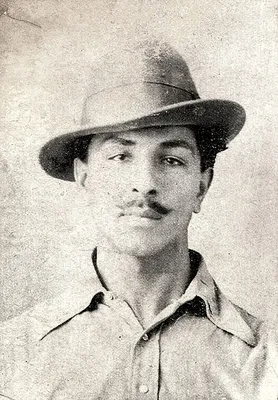
Bhagat Singh was an Indian revolutionary and folk hero executed at 23 for his anti-colonial activism.
Bhagat Singh (1907-1931) was an Indian revolutionary who became a prominent figure in the fight for India's independence. He was involved in acts of defiance against British rule, including a bombing of the Central Legislative Assembly and the mistaken murder of a British police officer, John P. Saunders, intended as retaliation for the death of Lala Lajpat Rai. This act, while controversial at the time, transformed Singh into a national symbol after his subsequent execution at the age of 23.
His actions and martyrdom, fueled by sympathetic media coverage and his own charismatic appeal, inspired a generation of Indian youth and prompted introspection within the Indian National Congress's nonviolent independence movement. Singh's embrace of socialist and atheist ideals, alongside his revolutionary fervor, garnered admiration across a wide political spectrum in India. He is remembered as a martyr and folk hero, particularly in Northern India, and is often referred to as Shaheed-e-Azam.
Early Life and Political Awakening
Born in 1907 in Punjab, Bhagat Singh came from a family involved in progressive politics. His father and uncle were active in movements against British rule. Singh received his education in Lahore, attending institutions like the National College, which was established in response to Gandhi's call for boycotting British-subsidized schools. His early involvement with revolutionary groups and his writings for various newspapers, often under pseudonyms, demonstrated his strong anti-British sentiments and his influence on young people. Authorities took note of his activism, leading to his arrest in 1927 on charges related to a bombing, though he was later released.
Revolutionary Activities and Martyrdom
Singh was a key member of the Hindustan Socialist Republican Association (HSRA). In 1928, seeking to avenge the death of nationalist leader Lala Lajpat Rai, who died after a police baton charge, Singh and his associates planned to assassinate the superintendent of police, James Scott. However, in a tragic case of mistaken identity, they shot and killed Assistant Superintendent John P. Saunders. Following this, Singh and an associate, Batukeshwar Dutt, staged a symbolic bombing in the Central Legislative Assembly in Delhi, showering leaflets and shouting slogans before allowing themselves to be arrested. This arrest brought his involvement in the Saunders case to light. While in jail, Singh participated in a hunger strike for better prison conditions, which gained significant public sympathy and solidified his image as a martyr. He was eventually convicted and executed by hanging in March 1931 at the age of 23.
Legacy and Symbolism
Bhagat Singh's execution at a young age transformed him into a powerful symbol of resistance and a folk hero in Northern India. Jawaharlal Nehru noted that Singh's popularity stemmed not from his acts of violence, but from his perceived vindication of national honor. He became an iconic figure, with songs and stories about him spreading rapidly throughout Punjab and beyond. Even years later, Singh, an atheist and socialist, continued to attract admiration from various political factions in India, including communists and Hindu nationalists. His enduring image as the 'Great Martyr' (Shaheed-e-Azam) cemented his place in Indian history and popular culture, inspiring countless others in the independence movement.
Key Ideas
- Anti-colonial revolution
- Socialism
- Atheism
- Martyrdom as a symbol of national honor
Notable Quotes
“Bhagat Singh did not become popular because of his act of terrorism but because he seemed to vindicate, for the moment, the honour of Lala Lajpat Rai, and through him of the nation. He became a symbol, the act was forgotten, the symbol remained, and within a few months each town and village of the Punjab, and to a lesser extent in the rest of northern India, resounded with his name.”
Books by Bhagat Singh Thind
1 free public domain book · Read online or download