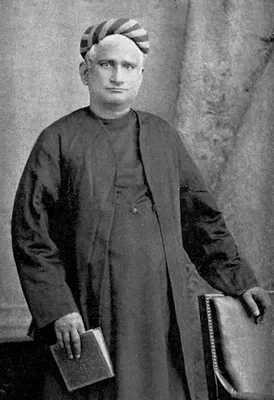
Bhabatosh Bhattacharya
Bankim Chandra Chattopadhyay was a pivotal Bengali author, poet, and journalist, celebrated as an 'Emperor of Literature'.
Bankim Chandra Chattopadhyay (1838–1894) was a prominent Indian Bengali novelist, poet, essayist, and journalist, widely considered a foundational figure in modern Bengali and Indian literature. He authored fourteen novels and numerous scholarly works in Bengali, including the landmark novel Anandamath (1882), which featured the patriotic song Vande Mataram. His writings, often breaking from traditional forms, inspired a literary renaissance across the Indian subcontinent. While he held a position in British government service and accepted the legitimacy of British rule, his works, particularly Anandamath, are seen as having fueled the Indian Independence movement.
Born into an orthodox Bengali Brahmin family, Chattopadhyay received a comprehensive education, graduating from Presidency College and later obtaining a law degree. He followed his father into government service, eventually retiring as a Deputy Magistrate and Collector. His career was marked by both recognition, such as the title Rai Bahadur and appointment as a Companion of the Order of the Indian Empire, and conflicts with the colonial administration. His literary output included historical fiction, essays on comparative literature, and commentaries on philosophical texts. He was also known for his pro-British and anti-Muslim stance, which he expressed through fictional narratives.
Literary Contributions and Philosophical Inquiries
Chattopadhyay's literary journey began with poetry before transitioning to prose, with his first published work being the English novel 'Rajmohan's Wife'. His first Bengali novel, 'Durgeshnandini' (1865), is considered a pioneering work in Bengali fiction. His essay 'Shakuntala, Miranda ebong Desdemona' (1873) is noted as an early instance of comparative literary analysis in Bengali literature. His political novel 'Anandamath' (1882) not only called for Indian nationalism but also contained the song Vande Mataram, which became a significant anthem for Indian nationalists. Chattopadhyay also engaged with philosophical ideas, offering commentary on the Bhagavad Gita and proposing in an essay that Sankhya philosophy formed the core of many Indian religious beliefs, including Buddhism. He critiqued Sankhya's emphasis on personal renunciation over societal engagement.
Views on Governance and Social Commentary
Within the context of British colonial rule, Bankim Chandra Chattopadhyay accepted its legitimacy and advocated for English education. His position as a British Government employee has led historians to interpret his acceptance of British rule as a strategic necessity, given his inability to produce work overtly critical of the administration. Despite this, his writings are credited with inspiring the later militant nationalist struggles within the Indian Independence movement. However, his perspective also included a pro-British stance and an anti-Muslim sentiment, which he conveyed through fictional portrayals of Muslims as oppressors and Hindus as victims, expressing a belief that Hindu rule would be jeopardized if the British departed.
Legacy and Influence
Bankim Chandra Chattopadhyay is revered as a key figure in the literary revival of Bengal and the broader Indian subcontinent. His innovative approach to writing, moving beyond traditional verse, provided inspiration for authors across India. He is widely known by the title 'Sahitya Samrat' (Emperor of Literature). His mentor, Rabindranath Tagore, described him as ambidextrous, capable of both literary creation and guiding aspiring writers. Sri Aurobindo characterized him as evolving from a poet and stylist to a seer and nation-builder. His novel 'Anushilan-Tattva' is credited with inspiring the formation of the Anushilan Samiti, a significant organization in the Indian independence movement. The West Bengal Government's highest award for Bengali fiction is named the Bankim Puraskar in his honor.
Key Ideas
- Personification of India as a Mother Goddess (Bharat Mata)
- Critique of Sankhya philosophy's emphasis on renunciation over social power
- Literary renaissance through breaking from traditional verse-oriented writing
Notable Quotes
“Bankim Chandra had equal strength in both his hands, he was a true sabyasachi (ambidextrous). With one hand, he created literary works of excellence; and with the other, he guided young and aspiring authors. With one hand, he ignited the light of literary enlightenment; and with the other, he blew away the smoke and ash of ignorance and ill conceived notions”
“The earlier Bankim was only a poet and stylist, the later Bankim was a seer and nation-builder”
Books by Bhabatosh Bhattacharya
1 free public domain book · Read online or download