✍️ Author Biography
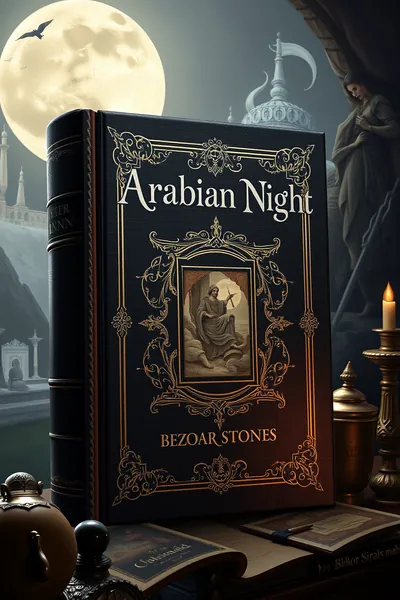
BEZOAR STONES
🌍 American
📚 1 free book
This text details the Arabic origins of various English words, focusing on their etymology and historical usage.
The provided text outlines the origins of numerous English words that have been adopted from Arabic, either directly or indirectly through other languages. These words typically entered Romance languages before reaching English and are included if etymology dictionaries confirm their Arabic descent. The list omits terms related to Islam and archaic or rare words, with a broader compilation available elsewhere. Each entry provides the Arabic root, its transliteration and pronunciation, and a historical account of its meaning and transmission into European languages and eventually English.
The etymological journeys described often span centuries and involve significant linguistic shifts. For instance, 'admiral' traces back to the Arabic 'amīr' (commander), evolving through medieval Latin and French. 'Adobe' comes from 'al-tūb' (brick), with its meaning shifting to 'sun-dried brick' in Spanish. 'Afrit' refers to a type of demon from Arabian Nights and the Quran. The entry for 'albatross' highlights a probable Arabic source 'al-ghattās' (the diver), which later incorporated a Latin element for 'white'. The word 'alchemy' itself originates from the Greek word for alchemy, adopted into Arabic and then Latin. The text also details words like 'alcohol', initially meaning fine powder, and 'alcove' from 'al-qobba' (vault or dome).
Linguistic Pathways from Arabic to English
The English lexicon has absorbed a significant number of words originating from Arabic. These linguistic imports often followed a complex path, first entering Romance languages before making their way into English. The source material emphasizes that inclusion in this list is contingent upon confirmation from etymological dictionaries, which trace the word's descent from Arabic. Excluded are terms specifically tied to Islamic religious practice and those considered archaic or exceptionally rare in contemporary English. The process of adoption frequently involved semantic shifts and phonetic adaptations across different languages and historical periods, illustrating the dynamic nature of word evolution.
Etymological Roots and Semantic Evolution
Entries like 'admiral' and 'adobe' exemplify the rich history behind these borrowed words. 'Admire', derived from the Arabic 'amīr' (commander), underwent transformations through medieval Latin and French, eventually acquiring its naval connotation. 'Adobe', stemming from 'al-tūb' (brick), evolved to specifically denote sun-dried bricks in Spanish before entering English. Terms such as 'afrit' connect to ancient folklore and religious texts like the Quran, referring to a type of jinn. The word 'albatross' likely originates from the Arabic 'al-ghattās' ('the diver'), with later European adoption incorporating a Latin root for 'white'.
Scientific and Technical Terminology
Arabic has also been a source for terms related to science and technology. 'Alchemy' itself, originating from a Greek term adopted by Arabic, entered Latin and became central to medieval European practices of metallurgy and early chemistry. 'Alcohol', initially referring to a fine powder (like stibnite or galena), later extended its meaning in European contexts, particularly through the work of Paracelsus, to include spirits obtained by distillation, such as 'alcohol of wine'. The apparatus for distillation, 'alembic', also traces its lineage to Arabic ('al-anbīq') from a Greek root ('ambix').
Words of Commerce and Agriculture
Several words related to trade, agriculture, and natural substances also have Arabic origins. 'Alfalfa', from the Arabic 'al-fisfisa', became the established name for the fodder crop in Spanish and subsequently English, particularly in the American West. 'Alkali', derived from 'al-qalī' (plant ash), was crucial in the production of inks, glass, and soap in medieval times and entered Western scientific texts. The term 'ambergris', a substance from sperm whales used in perfumery, likely came from Arabic sellers into Western languages, with the word eventually also encompassing the meaning of 'amber'.
Key Ideas
- English words often have origins in Arabic, transmitted through other languages.
- Etymological dictionaries are used to verify the Arabic lineage of words.
- Words related to Islamic religion, archaic terms, and very rare words are excluded.
- Many Arabic-derived words underwent semantic shifts and phonetic changes over time.
- Arabic has contributed terms in fields like science, technology, agriculture, and commerce.