Aḥmad ibn Idrīs, Bernd Radtke, John O'Kane
Jahannam is the Islamic concept of hell, a place of punishment described with vivid imagery and theological significance.
Jahannam represents the Islamic concept of hell, a place of punishment in the afterlife for evildoers, integral to Islamic theology and the Day of Judgment. Its description in Islamic texts, particularly the Qur'an, involves intense physical, psychological, and spiritual suffering, varying based on the individual's sins. While mainstream belief holds that confinement is temporary for Muslims and permanent for others, scholars debate the eternal nature of hell itself, with a majority view suggesting its eventual elimination by God's mercy.
The concept of Jahannam is influenced by earlier traditions, with its name potentially derived from the Hebrew Gehenna, a valley in Jerusalem associated with ancient sacrificial practices. Various names and descriptions exist for hell within Islamic literature, detailing its multiple levels, immense size, and specific torments. These descriptions often include descriptions of fire, boiling water, and agonizing food, alongside psychological suffering like humiliation and regret.
Theological Significance and Nature of Jahannam
Jahannam is a fundamental component of Islamic eschatology, representing the realm of punishment for those who commit wrongdoing in this life. It is intrinsically linked to the Day of Judgment, a core tenet of Islamic faith. The suffering experienced in Jahannam is described as multifaceted, encompassing physical pain, psychological distress, and spiritual torment, with the intensity and nature of punishment tailored to the individual's transgressions. While the Qur'an vividly portrays the horrors of hell, often contrasting them with the pleasures of paradise (Jannah), there is a theological nuance regarding the duration of punishment. Mainstream belief suggests temporary confinement for Muslims but permanent for non-Muslims, though scholarly discourse acknowledges differing views on whether hell is eternal or will ultimately be dissolved by divine mercy. A common understanding is that Jahannam, like Jannah, exists concurrently with the temporal world rather than being created post-Judgment.
Descriptions and Imagery of Jahannam
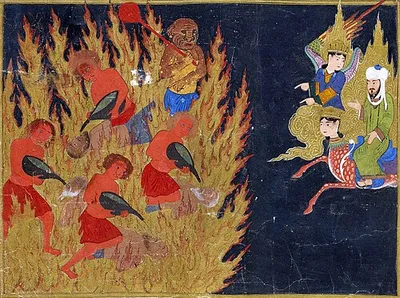
Islamic texts, especially the Qur'an, offer extensive and varied physical descriptions of Jahannam. It is often depicted as vast and situated beneath paradise, comprising seven levels, each progressively more severe. Alternative descriptions portray it as a colossal pit over which the resurrected must traverse the bridge of As-Sirāt. The environment is characterized by extreme heat, with mountains, rivers, and oceans filled with noxious fluids. Some accounts even attribute sentience to hell, suggesting it can move and question. The Qur'an itself contains hundreds of references to Jahannam and its various names, such as 'the Fire' (al-nar) and 'the Blazing Fire' (jaheem). Specific Qur'anic verses detail torments like roaring flames, boiling water, scorching winds, and black smoke, emphasizing a focus on skin sensation and digestion in its punishments. Inmates are described as suffering from thirst and hunger, consuming thorny plants, ghisslin, and the heads of devils from the Zaqqum tree, while being bound in chains and guarded by stern angels.
Origins and Alternative Names
The concept of hell in Islam appears to draw from earlier traditions, with the name 'Jahannam' potentially originating from the Hebrew 'Gehenna,' referring to a valley near Jerusalem associated with ancient child sacrifice. This historical context, particularly the practice of passing individuals over fire, is seen as a possible influence on Islamic descriptions of hellfire and its guardian, Malik. Beyond the primary term 'Jahannam,' numerous other names are used, often signifying different gates or aspects of hell. These include 'al-nar' (the fire), 'jaheem' (blazing fire), 'hutamah' (that which breaks to pieces), 'haawiyah' (the abyss), 'sa'eer' (the blaze), and 'Saqar' (place of burning). The precise location of hell is subject to diverse traditions, ranging from the lowest earth to surrounding the globe, with specific entrances speculated to be in geographical locations like the sea, a sulphurous well in Hadramawt, the Valley of Hinnom, or a gorge in Afghanistan.
Key Ideas
- Jahannam: The Islamic concept of hell, a place of punishment in the afterlife.
- Day of Judgment: Jahannam is an essential element of the Islamic Day of Judgment.
- Levels of Hell: Descriptions often include seven distinct levels of increasing severity.
- Torments: Punishments involve physical, psychological, and spiritual suffering, including fire, boiling water, and agonizing food.
- Duration of Punishment: Debate exists on whether confinement in hell is eternal or temporary.
Notable Quotes
“Surely hell lies in wait, A place of resort for the inordinate, Living therein for ages.”
“They shall not taste therein cool nor drink But boiling water and filth, as a corresponding recompense.”
“Surely they did not feared the account, and they rejected Our messages as lies.”
“And We have recorded everything in a book, So taste! For We will not increase you in anything except torment.”
“Hell is described as being located below Paradise, having seven gates and "for every gate there shall be a specific party" of sinners (Q.15:43–44).”
Books by Aḥmad ibn Idrīs, Bernd Radtke, John O'Kane
4 free public domain books · Read online or download