Bennett-Goleman
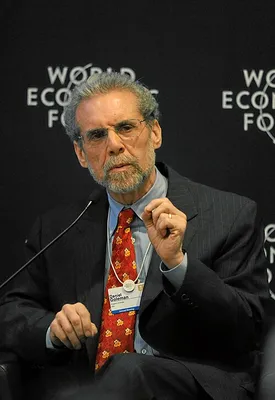
Daniel Goleman is a psychologist and journalist known for popularizing emotional intelligence and exploring meditation's effects.
Daniel Goleman, born March 7, 1946, is an American psychologist and science journalist recognized for his extensive work on emotional intelligence. He spent twelve years as a journalist for The New York Times, focusing on behavioral sciences and the brain. His 1995 book, "Emotional Intelligence," achieved significant international success, remaining on bestseller lists for an extended period and being translated into numerous languages. Beyond this seminal work, Goleman has authored books addressing a wide array of subjects, including self-deception, creativity, transparency, meditation, social-emotional learning, ecological awareness, and the philosophical perspectives of the Dalai Lama.
Goleman's academic background includes a magna cum laude degree from Amherst College and a Ph.D. in clinical psychology from Harvard University. His postgraduate studies, supported by fellowships, took him to India, where he engaged with spiritual traditions and teachers, influencing his early writings. He later taught at Stanford and was instrumental in co-founding organizations dedicated to social and emotional learning (CASEL) and the study of emotional intelligence in professional settings (CREIO). Goleman's career has been marked by numerous accolades, including nominations for the Pulitzer Prize and awards for his contributions to science journalism and the communication of behavioral sciences.
Exploration of Consciousness and Meditation
Goleman's early engagement with Eastern traditions, particularly during his studies in India, laid the groundwork for his exploration of consciousness and meditation. His first book, "The Varieties of Meditative Experience" (later republished as "The Meditative Mind"), delves into various meditation systems, highlighting the consistent role of attention training, whether through concentration or mindfulness, as a universal element in altering consciousness. This research underscores a deep interest in the psychological and physiological effects of contemplative practices, connecting ancient wisdom with modern scientific inquiry. His work suggests that these practices offer a pathway to understanding and potentially transforming one's mental landscape.
Emotional Intelligence and its Applications
The concept of emotional intelligence, which Goleman brought to widespread public attention, encompasses self-awareness, emotional regulation, empathy, and social skills. He argues that these competencies are crucial not only for personal well-being but also for professional success, often rivaling the importance of traditional IQ. His influential book "Emotional Intelligence" has become a cornerstone in understanding human interaction and leadership. Goleman further extended these ideas into organizational contexts through works like "Working with Emotional Intelligence" and "Primal Leadership," advocating for the integration of emotional and social competencies in leadership and workplace effectiveness. He co-founded organizations like CASEL and CREIO to promote the study and application of these principles in education and business.
Mindfulness and Focus in Modern Life
In his later work, such as "Focus: The Hidden Driver of Excellence," Goleman examines the significance of mindfulness in achieving excellence, particularly in demanding professional environments. He proposes a "triple-focus" model—inner, other, and outer attention—as essential for high achievers. This framework suggests that cultivating self-awareness (inner), empathy (other), and environmental understanding (outer) is key to effective concentration and leadership. Goleman emphasizes that mastering these attentional skills, particularly through mindfulness, enables individuals to navigate complexity, manage distractions, and guide collective efforts, making it a critical asset for leaders and professionals alike.
Key Ideas
- Emotional Intelligence: The capacity to be aware of, control, and express one's emotions, and to handle interpersonal relationships judiciously and empathetically.
- The "triple-focus" of attention (inner, other, outer) as a key to excellence and leadership.
- The invariant role of attention training in various meditation systems for altering consciousness.
Books by Bennett-Goleman
0 free public domain books · Read online or download