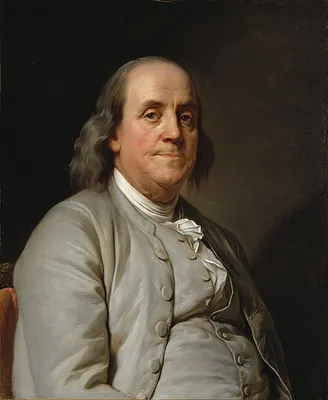
Benjamin Franklin
Benjamin Franklin was a multifaceted American figure known for his contributions to science, politics, printing, and philosophy.
Benjamin Franklin was a prominent American polymath whose influence spanned writing, science, invention, statesmanship, and philosophy. He played a crucial role as one of the Founding Fathers of the United States, participating in the drafting and signing of the Declaration of Independence and serving as the first postmaster general. Born in colonial Massachusetts, Franklin established himself as a successful printer and publisher in Philadelphia, notably with The Pennsylvania Gazette and Poor Richard's Almanack, under the pseudonym "Richard Saunders". His intellectual pursuits extended to founding civic organizations, including the Library Company of Philadelphia and the Academy and College of Philadelphia, which later became the University of Pennsylvania. He was also a key figure in the American Philosophical Society. Franklin's diplomatic efforts, particularly in securing French support during the American Revolution, and his advocacy for colonial unity earned him significant admiration. His scientific inquiries, especially into electricity, and his numerous inventions, such as the lightning rod and bifocals, cemented his legacy as a leading intellectual of the American Enlightenment.
Early Life and Intellectual Foundations
Born in Boston, Benjamin Franklin's early education was limited by his family's financial circumstances, leading him to pursue knowledge through extensive reading. Apprenticed to his printer brother at age twelve, he quickly learned the trade and demonstrated an early aptitude for writing and advocacy. He famously used the pseudonym "Silence Dogood" to publish letters in his brother's newspaper, The New-England Courant, showcasing his wit and engaging public discourse. This period also fostered his commitment to free speech. After leaving his apprenticeship without permission, Franklin moved to Philadelphia, where he eventually established his own printing house and became the publisher of The Pennsylvania Gazette. His early involvement in community affairs led to the formation of the Junto, a discussion group aimed at self-improvement and civic betterment, which served as a precursor to the Library Company of Philadelphia, an early subscription library.
Statesmanship, Diplomacy, and Abolitionism
Franklin's career extended into significant public service and diplomacy. He served as an agent for several colonies in London, successfully advocating for the repeal of the Stamp Act, which garnered him heroic status in North America. His diplomatic skills were particularly evident during his tenure as the first U.S. ambassador to France, where he was instrumental in fostering positive relations and securing vital French aid for the American Revolution. He also served as President of Pennsylvania. While Franklin initially owned slaves and advertised them for sale in his newspaper, he later became a vocal abolitionist, advocating against slavery and promoting the integration of African Americans into society. His advocacy for colonial unity earned him the moniker "The First American."
Scientific Pursuits and Inventions
As a scientist, Benjamin Franklin made significant contributions that placed him at the forefront of the American Enlightenment and the history of physics. His research into electricity was groundbreaking, and he is credited with inventing the lightning rod, a device that drastically improved safety from electrical storms. Beyond electricity, Franklin's inventiveness extended to practical innovations such as bifocals, the glass harmonica, and the Franklin stove. He also made contributions to navigation and meteorology, notably charting and naming the Gulf Stream. His founding of numerous civic organizations, including educational institutions and the first fire department in Philadelphia, underscores his commitment to societal progress and innovation.
Key Ideas
- Importance of self-improvement and civic engagement
- Advocacy for free speech and press
- Colonial unity and American independence
- Scientific inquiry and practical invention
- Abolition of slavery
Notable Quotes
“A proposition was made by me that since our books were often referr'd to in our disquisitions upon the inquiries, it might be convenient for us to have them altogether where we met, that upon occasion they might be consulted; and by thus clubbing our books to a common library, we should, while we lik'd to keep them together, have each of us the advantage of using the books of all the other members, which would be nearly as beneficial as if each owned the whole.”
Books by Benjamin Franklin
1 free public domain book · Read online or download