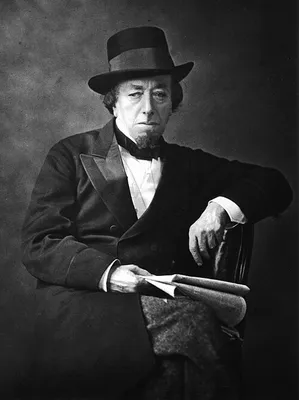
Benjamin Disraeli
Benjamin Disraeli was a British Prime Minister, Conservative leader, and writer, notable for his political influence and Jewish heritage.
Benjamin Disraeli, born in 1804, was a prominent British statesman who served twice as Prime Minister. He significantly shaped the modern Conservative Party, defining its policies and broadening its appeal. Disraeli was instrumental in establishing the party's association with the British Empire and military expansion, which resonated with the electorate. He is uniquely remembered as the only British prime minister to have been born Jewish. His political career, marked by significant rivalries, particularly with William Ewart Gladstone, and his concept of 'one-nation conservatism' or 'Tory democracy,' left a lasting impact on British politics.
Disraeli's early life involved a conversion to Anglicanism at age 12, following his father's dispute with the synagogue. Despite early setbacks, he entered Parliament in 1837. His political ascent was aided by his prominent role in the party schism over the Corn Laws and subsequent leadership positions under Lord Derby. He later served as Prime Minister, notably during a period of international tension involving the Ottoman Empire, where he secured British interests in the Suez Canal and brokered peace at the Congress of Berlin. Despite diplomatic successes, his second term faced challenges from overseas conflicts and domestic economic issues, leading to his electoral defeat in 1880. Disraeli also pursued a literary career, publishing novels throughout his life.
Early Life and Conversion
Born Benjamin D'Israeli in London in 1804 to a literary critic and historian father of Sephardic Jewish background, Benjamin Disraeli's early life was marked by his family's eventual departure from Judaism. Following a dispute at his synagogue in 1813, his father renounced the faith, and Benjamin, along with his siblings, was baptized into the Church of England in 1817. This conversion, occurring when he was twelve, was significant as it enabled him to pursue a political career, as taking an oath on the 'true faith of a Christian' was a requirement for Members of Parliament until 1858. Disraeli's education was primarily classical, though he later expressed regret about not attending a more prestigious public school. He initially trained in law, articled to a solicitor, but harbored ambitions for Parliament, influenced by his father's admiration for a prominent solicitor who was also an MP. He eventually shifted his focus towards a literary career, though he also engaged in speculative stock market dealings.
Political Ascent and Prime Ministerships
Disraeli entered the House of Commons in 1837 after several attempts. He rose to prominence within the Conservative Party, particularly after the 1846 split over the repeal of the Corn Laws, where he became a leading figure in opposition to Prime Minister Robert Peel. During the 1850s and 1860s, he served in government under Lord Derby, holding key roles such as Chancellor of the Exchequer and Leader of the House of Commons. In 1868, he briefly became Prime Minister before losing a general election. He returned to lead the party to a majority victory in 1874, beginning his second term as Prime Minister. This period was significantly shaped by international affairs, including the decline of the Ottoman Empire and British involvement in the Suez Canal. He also played a crucial role in the Congress of Berlin in 1878, securing a diplomatic outcome favorable to Britain.
Later Career and Legacy
Disraeli's second premiership faced challenges, including controversial military engagements in Afghanistan and South Africa, which eroded public support. His refusal to reinstate grain tariffs, despite agricultural hardship, alienated some voters. The Liberal leader William Ewart Gladstone conducted a vigorous campaign, contributing to the Conservatives' defeat in the 1880 general election. Disraeli spent his final months leading the party in opposition. Throughout his career, he maintained a close relationship with Queen Victoria, who elevated him to the peerage as Earl of Beaconsfield in 1876. Beyond politics, Disraeli was also a prolific writer, publishing novels from 1826 until shortly before his death in 1881. His political philosophy, often termed 'one-nation conservatism' or 'Tory democracy,' emphasized national unity and the role of the state in social welfare, while his association with the British Empire and military strength defined the Conservative Party for an era.
Key Ideas
- One-nation conservatism
- Tory democracy
Books by Benjamin Disraeli
2 free public domain books · Read online or download