Benedictus Figulus
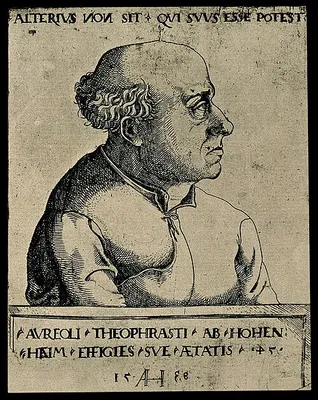
Paracelsus was a Renaissance physician, alchemist, and philosopher who revolutionized medicine with observation and challenged traditional practices.
Theophrastus von Hohenheim, known as Paracelsus, was a pivotal figure of the German Renaissance, serving as a physician, alchemist, and philosopher. Born in Switzerland, his father, a physician, provided his early education in medicine and natural sciences. Paracelsus also received a broad humanistic and theological education. He pursued medical studies at universities and earned his doctorate, but he diverged from conventional academic paths.
Driven by a desire for universal knowledge beyond traditional texts, Paracelsus traveled extensively throughout Europe. He served as an army surgeon and engaged with various cultures and medical traditions. His career was marked by a confrontational approach to established medical authorities. He emphasized empirical observation and practical experience, famously stating that "the patients are your textbook, the sickbed is your study." This led to public disputes and criticism of established medical figures like Galen and Avicenna, whom he publicly denounced.
Paracelsus's influence extended beyond medicine into areas of prophecy and divination, with his "Prognostications" being studied by Rosicrucians. His medical movement, Paracelsianism, shaped early modern medical thought. He challenged prevailing treatments, such as for syphilis, and developed his own philosophical framework for medicine, articulated in works like "Paragranum" and "Opus Paramirum."
Revolutionary Medical Practice and Philosophy
Paracelsus fundamentally altered the landscape of Renaissance medicine by championing empirical observation and challenging established doctrines. He believed true medical knowledge derived from practical experience rather than solely from ancient texts. This led him to advocate for direct engagement with patients, declaring them the ultimate source of learning. His approach was holistic, considering the patient's environment and the interplay of natural forces in health and disease. He also emphasized the importance of chemical and mineral remedies, laying groundwork for iatrochemistry, a branch of medicine that uses chemical remedies.
Challenging Authority and Conventional Wisdom
A controversial figure, Paracelsus openly defied the medical establishment of his time. He famously burned the works of classical authorities like Galen and Avicenna, symbolizing his rejection of their unquestioned authority. His lectures, delivered in German rather than Latin, were intended to be accessible to a wider audience, further disrupting academic norms. He criticized physicians and apothecaries, prioritizing practical skill and genuine understanding over titles and academic credentials. This confrontational stance often led to threats and persecution, forcing him to move frequently throughout his career.
Esoteric and Prophetic Dimensions
Beyond his medical innovations, Paracelsus possessed a significant prophetic and divinatory dimension. His "Prognostications" were particularly influential, attracting the attention of esoteric groups like the Rosicrucians in the 17th century. His philosophical writings, such as "Paragranum" and "Paramirum," explored profound questions about life, death, the human place in the universe, and the divine. These works suggest a worldview that integrated natural philosophy with spiritual and mystical insights, reflecting the broader intellectual currents of the Renaissance.
Key Ideas
- Emphasis on observation in medicine
- Father of toxicology
- Challenging traditional medical authorities
- Holistic approach to health
- Influence on Rosicrucians through prognostication
Notable Quotes
“The patients are your textbook, the sickbed is your study.”
“I leave it to Luther to defend what he says and I will be responsible for what I say. That which you wish to Luther, you wish also to me: You wish us both in the fire.”
Books by Benedictus Figulus
2 free public domain books · Read online or download