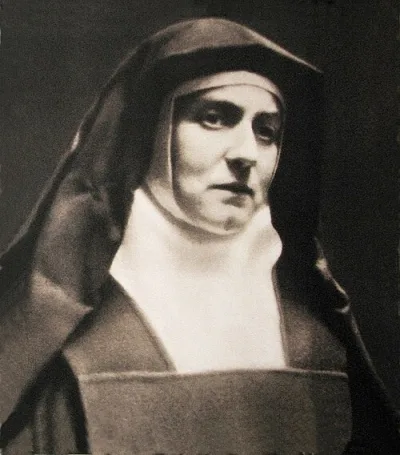
Edith Stein, a Jewish convert to Catholicism and Carmelite nun, was a philosopher murdered by Nazis and is a Catholic saint.
Edith Stein, known in religion as Teresa Benedicta of the Cross, was a German philosopher of Jewish heritage who converted to Catholicism and became a Discalced Carmelite nun. Born into an observant Jewish family, she became an agnostic in her youth. Her experiences during World War I and her philosophical studies, particularly her doctoral work on empathy under Edmund Husserl, shaped her intellectual journey. A pivotal moment was reading the autobiography of Teresa of Ávila, which led to her baptism into the Catholic Church in 1922.
Initially pursuing a teaching career, Stein was forced to resign due to Nazi antisemitic laws. She eventually entered the Discalced Carmelite order in 1933, taking the name Teresia Benedicta a Cruce. To escape Nazi persecution, she and her sister were transferred to a monastery in the Netherlands. Tragically, they were arrested by the Gestapo in 1942 and sent to Auschwitz, where they were murdered. Stein has since been canonized as a martyr and saint and is a patron saint of Europe.
Philosophical Pursuits and Conversion
Edith Stein, born into a religious Jewish family, developed into a gifted child with a keen intellect. By her teenage years, she had adopted an agnostic stance. Her academic path led her to study philosophy, where she pursued doctoral studies in empathy under Edmund Husserl at the University of Freiburg. Her dissertation on the problem of empathy earned her a doctorate with highest honors. Stein's academic career was marked by her contributions to phenomenology, though her attempts at habilitation were hindered by her gender. Her intellectual development took a significant turn when she encountered the writings of Teresa of Ávila, a reformer of the Carmelite order. This encounter profoundly influenced her, leading to her conversion to Catholicism in 1922.
Entry into Religious Life and Martyrdom
Following her conversion, Edith Stein desired to join the Discalced Carmelites but was initially advised against it. She taught at a Jewish school of education and later at an institute affiliated with the Catholic Church. However, escalating antisemitic legislation enacted by the Nazi government forced her to leave her teaching position. In 1933, she finally entered the Discalced Carmelite monastery in Cologne, taking the religious name Teresia Benedicta a Cruce. To ensure their safety from the rising Nazi threat, she and her sister Rosa, also a convert, were transferred to a Carmelite monastery in the Netherlands. In 1942, following a pastoral letter by Dutch bishops condemning Nazi treatment of Jews, baptized Catholics of Jewish origin were arrested. Edith and Rosa Stein were among those arrested and subsequently deported to Auschwitz, where they were murdered in the gas chambers.
Key Ideas
- Phenomenology
- Empathy as a philosophical concept
- Bridging phenomenology and Thomism
- Theological reflection on suffering and the cross
Notable Quotes
“As a child of the Jewish people who, by the grace of God, for the past eleven years has also been a child of the Catholic Church, I dare to speak to the Father of Christianity about that which oppresses millions of Germans.”
“For weeks we have seen deeds perpetrated in Germany which mock any sense of justice and humanity, not to mention love of neighbor.”
“But the responsibility must fall, after all, on those who brought them to this point and it also falls on those who keep silent in the face of such happenings.”
“Everything that happened and continues to happen on a daily basis originates with a government that calls itself 'Christian'.”
“For weeks not only Jews but also thousands of faithful Catholics in Germany, and, I believe, all over the world, have been waiting and hoping for the Church of Christ to raise its voice to put a stop to this abuse of Christ's name.”
Books by
10 free public domain books · Read online or download