Ben Steigmann
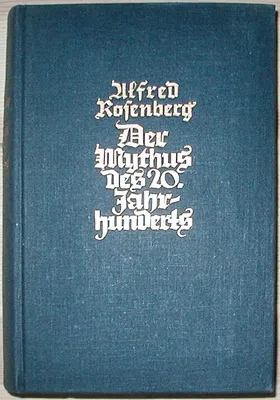
Alfred Rosenberg's "The Myth of the Twentieth Century" promoted Nazi racial ideology, blending pseudo-science with mysticism.
Alfred Rosenberg's "The Myth of the Twentieth Century," published in 1930, was a significant but controversial work within Nazi ideology. The book posited that the Aryan race was the origin of ancient civilizations, which subsequently declined due to interbreeding with "lesser races." Rosenberg argued for the supremacy of the "Nordic race," asserting that Jewish influence was responsible for societal decay. He proposed that a state should enforce the rule of "higher" races over "lower" ones, explicitly advocating against interbreeding.
The book, which sold over a million copies by 1944, received a state prize from Hitler in 1937, lauded for laying a foundational understanding of National Socialism. Its content combined racist pseudo-science with mystical elements, suggesting the "Nordic race" originated in Atlantis, which Rosenberg used as a symbolic term for an Aryan homeland. This ideology justified the subjugation and even extermination of non-Aryan peoples. Despite its official praise, some Nazi leaders privately found the book embarrassing or dismissed it as "mysticism" and "nonsense."
Rosenberg drew inspiration from figures like Houston Stewart Chamberlain and Arthur de Gobineau, viewing his work as a continuation of Chamberlain's ideas. The book also incorporated interpretations of Nietzsche, Wagner's romanticism, and mystical vitalism. Despite its influence on Nazi ideology and figures like Rudolf Höss, Hitler himself did not consider it official party doctrine. The book's overtly anti-Christian stance led to criticism and its inclusion on the Catholic Church's Index of Forbidden Books.
Ideological Foundations and Content
Alfred Rosenberg's "The Myth of the Twentieth Century" is characterized as a pseudo-scientific and pseudo-historical text central to Nazi ideology. The core argument presented is that the Aryan race is the progenitor of advanced ancient civilizations, which later deteriorated due to mixing with supposedly inferior races. Rosenberg championed the "Nordic race" as the apex of human development and attributed societal degradation to Jewish influences. He advocated for a hierarchical social order where "higher" races would dominate "lower" ones, prohibiting intermarriage. The book incorporated mystical notions, positing an Atlantean origin for the "Nordic race," though Atlantis was presented metaphorically as a homeland rather than a literal lost continent. This framework served to legitimize racial segregation and violence against non-Aryan populations.
Influences and Reception
Rosenberg's intellectual lineage traces back to European racial theorists such as Houston Stewart Chamberlain, whose work "The Foundations of the Nineteenth Century" he considered a precursor, and Arthur de Gobineau. His ideology also incorporated a selective reading of Friedrich Nietzsche, the romanticism associated with Richard Wagner, and elements of mystical vitalism. The book's reception was complex; while it achieved significant sales and official recognition within the Nazi regime, including a state prize awarded by Hitler, many prominent Nazis privately disparaged its content. Figures like Joseph Goebbels and Hermann Göring reportedly mocked it, with Goebbels calling it a "philosophical belch." Despite its official backing, Hitler himself privately dismissed it as "mysticism" and "nonsense."
Esoteric and Mystical Dimensions
Beyond its racial pseudo-science, "The Myth of the Twentieth Century" delves into esoteric and mystical themes. Rosenberg advanced the idea of a "Nordic race" originating from a mythical homeland, which he symbolically linked to Atlantis. This blend of racial theory and mysticism aimed to construct a pseudo-historical narrative that supported Nazi ambitions. The book's mystical vitalism and references to ancient myths contributed to its appeal among those seeking an alternative to modernity. Its occult undertones and anti-Christian sentiments were significant, leading to its condemnation by the Catholic Church and its inclusion on the Index Librorum Prohibitorum. Rosenberg later penned replies to critics, further engaging with these controversies.
Key Ideas
- Aryan supremacy and the decline of civilizations due to interbreeding.
- Jewish influence as a cause of moral and social degradation.
- Racial hierarchy and the necessity of ruling-class domination.
- The "Nordic race" originating from a mythical homeland (symbolically Atlantis).
- Blending of racial pseudo-science with mystical and esoteric concepts.
Books by Ben Steigmann
1 free public domain book · Read online or download