Ben Meulenbeld
Humorism was an ancient medical theory positing four bodily fluids regulated health, temperament, and disease.
Humorism, also known as humoral theory or humoralism, was a comprehensive medical and philosophical system developed by ancient Greek and Roman physicians. It proposed that the human body's composition and functions were governed by four essential "humors": blood, phlegm, yellow bile, and black bile. The theory suggested that health depended on a balanced proportion and mixture of these bodily fluids, while illness arose from an excess or deficiency of one or more humors.
This system, influenced by earlier concepts from Egypt and Mesopotamia, was significantly shaped by thinkers like Alcmaeon of Croton and, most notably, Hippocrates and Galen. Galen, in particular, expanded upon Hippocrates' ideas, linking the humors not only to physical health but also to personality types, or temperaments. The theory also incorporated environmental factors, diet, and life stages as influences on the humors. Although influential for centuries, humorism began to decline in the 17th century and was ultimately superseded by modern scientific understanding, particularly with the discovery of microorganisms.
Origins and Development of Humoral Theory
The concept of "humors" may have roots in ancient Egyptian or Mesopotamian medicine, but it was systematized by ancient Greek philosophers and physicians. The term itself is a translation of the Greek word for "juice" or "sap." Early Indian Ayurvedic medicine also presented theories involving three or four "doṣas," sometimes linked to five elements. The idea gained prominence through medical theorists like Alcmaeon of Croton, who proposed a system of humors linked to fundamental elements. Hippocrates is widely credited with applying this to medicine, identifying the vital bodily fluids—blood, phlegm, yellow bile, and black bile—as the key humors. He and later Galen posited that imbalances in these fluids, whether excess or deficiency, led to illness, while a harmonious balance constituted health. The treatise "On the Nature of Man," attributed to Hippocrates and elaborated by Galen, became a foundational text for humoral theory. Galen's authority significantly contributed to the theory's enduring success.
Humors, Temperaments, and Disease
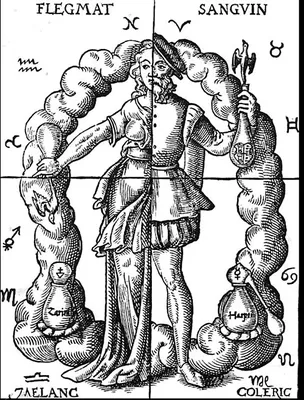
The humoral theory proposed that a balanced mixture of the four humors—blood, phlegm, yellow bile, and black bile—was essential for maintaining health, a state known as eucrasia or eukrasia. Conversely, an imbalance, termed dyscrasia, was considered the direct cause of all diseases. Galen further developed this by linking the qualities of the humors (warm, cold, moist, dry) to temperaments. He identified four primary temperaments based on the predominance of one quality and four secondary ones based on combinations. The four temperaments that became widely known—sanguine, choleric, melancholic, and phlegmatic—were associated with the humors and influenced not only a person's physical health and susceptibility to disease but also their behavioral and emotional tendencies. Disease could also arise from the "corruption" of humors due to environmental factors, diet, or other influences.
Treatment and Decline
In humoral medicine, treatments aimed to restore the balance of the humors within the body. When a patient suffered from a surplus or imbalance of a particular humor, interventions were employed to remove the excess. Common methods included purging, bloodletting (venesection), catharsis, and diuresis. Bloodletting became particularly significant, especially after Galen declared blood to be the most prevalent humor, with varying amounts extracted based on the patient's condition. While humoral theory, heavily influenced by the authority of Galen, remained dominant for centuries and was adopted and adapted by later medical establishments, its influence began to wane in the 17th century. The definitive disproval of the theory ultimately came with the advent of modern scientific discoveries, most notably the identification of microbes as the cause of many diseases.
Key Ideas
- Health is a balance of four bodily fluids (humors): blood, phlegm, yellow bile, and black bile.
- Illness results from an excess or deficiency of one or more humors.
- Humors influence physical health, temperament, and susceptibility to disease.
- Environmental factors, diet, and life stages affect the balance of humors.
- Treatments aimed to restore humoral balance through methods like bloodletting and purging.
Notable Quotes
“The Human body contains blood, phlegm, yellow bile, and black bile. These are the things that make up its constitution and cause its pains and health. Health is primarily that state in which these constituent substances are in the correct proportion to each other, both in strength and quantity, and are well mixed. Pain occurs when one of the substances presents either a deficiency or an excess, or is separated in the body and not mixed with others. The body depends heavily on the four humors because their balanced combination helps to keep people in good health. Having the right amount of humor is essential for health. The pathophysiology of disease is consequently brought on by humor excesses and/or deficiencies.”
Books by Ben Meulenbeld
1 free public domain book · Read online or download