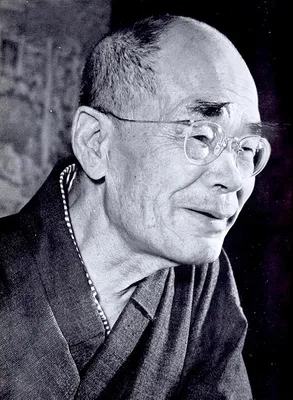
Beatrice Lane Suzuki
D.T. Suzuki was a pivotal figure in introducing Zen and Mahayana Buddhism to the West through his extensive writings and lectures.
Daisetz Teitaro Suzuki (1870–1966) was a Japanese scholar and essayist renowned for his profound expertise in Buddhism, particularly Zen and Shin traditions. He played a crucial role in popularizing these philosophies in Western countries. Suzuki also translated numerous literary works from various East Asian languages.
Born Teitarō Suzuki in Kanazawa, he faced early hardship after his father's death, leading him to seek answers in religion. His intellectual curiosity led him to study at Waseda and Tokyo Universities, where he acquired knowledge of multiple languages and began Zen practice. A significant period of his life involved living and collaborating with scholar Paul Carus in Illinois, translating Eastern spiritual texts.
Suzuki's career included professorships at Gakushuin University, Tokyo University, and Ōtani University. He co-founded the Eastern Buddhist Society with his wife, Beatrice Lane Suzuki, which published the scholarly journal "The Eastern Buddhist." He traveled extensively, lecturing at Western universities and contributing significantly to the global understanding of Buddhist philosophy.
Early Life and Philosophical Inquiries
Born Teitarō Suzuki in Kanazawa, Japan, his family experienced poverty following his father's death. Raised by his mother, a Jōdo Shinshū Buddhist, Suzuki's sharp intellect led him to explore various religious traditions in search of meaning. His philosophical inclinations found some existing cosmologies difficult to accept, prompting deeper investigation into spiritual and philosophical concepts.
Academic Pursuits and Western Introduction
Suzuki pursued higher education at Waseda and the University of Tokyo, mastering languages such as Chinese, Sanskrit, and Pali. During his studies, he engaged in Zen practice at Engaku-ji in Kamakura. A pivotal experience involved living with scholar Paul Carus in Illinois, where he assisted in translating Eastern spiritual literature, including the Tao Te Ching, and began writing "Outlines of Mahayana Buddhism."
Academic Career and Eastern Buddhist Society
Suzuki held academic positions at Gakushuin University and Tokyo University before becoming a professor at Ōtani University in Kyoto. In 1921, he and his wife, Beatrice Lane Suzuki, established the Eastern Buddhist Society, dedicated to promoting Mahayana Buddhism through lectures, seminars, and the publication of "The Eastern Buddhist" journal. He was also an expert on Kegon philosophy, viewing it as an intellectual complement to Zen.
Dissemination of Zen in the West
Suzuki's extensive writings and lectures were instrumental in introducing Zen Buddhism to Western audiences. He lectured at American universities, including Columbia University, and taught about the history and practice of Zen and Chan Buddhism. His works often focused on classical Chan texts like the Blue Cliff Record and the Gateless Passage, exploring their philosophical implications and the unique way of life developed within Chinese Buddhism.
Later Interests and Scholarly Contributions
In his later years, Suzuki revisited the Jōdo Shinshū faith of his mother and lectured on it. He also showed interest in Christian mysticism, drawing parallels between figures like Meister Eckhart and the Myokonin of Jōdo Shinshū, bringing research on the latter to international attention. His prolific output included works like "Essays in Zen Buddhism" and "Zen and Japanese Culture," solidifying his reputation as a leading authority on Buddhist philosophy.
Key Ideas
- Zen awakening as a goal, developed within a Chinese social context involving mundane tasks and everyday life.
- The intellectual explication of Zen experience through Kegon philosophy.
- The comparison of Zen's direct experience with Western mystical traditions.
- The significance of Jōdo Shinshū Buddhism as a major East Asian Mahayana development.
Notable Quotes
“Suzuki in his later years was not just a reporter of Zen, not just an expositor, but a significant contributor to the development of Zen and to its enrichment.”
Books by Beatrice Lane Suzuki
1 free public domain book · Read online or download