Barbara Schildkrout
Joan of Arc was a peasant girl who believed she was divinely guided to lead France to victory during the Hundred Years' War, becoming a national symbol and saint.
Joan of Arc, born around 1412 in northeastern France to a peasant family, became a central figure in the Hundred Years' War. She claimed divine guidance from saints Michael, Margaret, and Catherine, which she believed compelled her to support Charles VII and expel English forces from France. At about seventeen, she was sent to Orléans, where her arrival inspired the French army, leading to the lifting of the siege. Her subsequent military successes, including the victory at Patay, paved the way for Charles VII's coronation in Reims.
Following the coronation, Joan's military fortunes shifted with unsuccessful sieges, and she was captured by Burgundian troops in 1430. Handed over to the English, she was tried for heresy by Bishop Pierre Cauchon, accused of blasphemy and demonic visions. Declared guilty, she was burned at the stake in 1431 at the age of nineteen. Her trial was later overturned in 1456, and she was eventually canonized in 1920, becoming a national symbol and patron saint of France, revered as a martyr.
Divine Guidance and Military Leadership
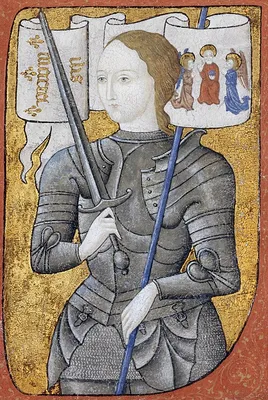
Joan of Arc asserted that her actions were dictated by divine messages from celestial beings, primarily Archangel Michael, Saint Margaret, and Saint Catherine. These visions began in her youth, around the age of thirteen, after her village experienced a raid. She described these experiences as profound, leading her to vow virginity. Driven by this perceived celestial mandate, she sought to aid the Dauphin Charles VII in reclaiming France from English occupation during the Hundred Years' War. Her conviction and claims of divine backing convinced authorities to grant her a role in the military. She arrived at the siege of Orléans wielding her banner, a symbol that galvanized the demoralized French forces and contributed significantly to the lifting of the siege within days. Her military leadership extended to encouraging aggressive pursuit of the English, culminating in the victory at Patay, which opened the path to Reims for Charles VII's coronation.
Trial, Execution, and Rehabilitation
Despite her early successes, Joan's military involvement led to subsequent setbacks, including the unsuccessful sieges of Paris and La Charité. These defeats diminished the court's confidence in her. Her capture by Burgundian forces in 1430 marked a turning point, leading to her transfer to English custody. She was subsequently put on trial for heresy, presided over by Bishop Pierre Cauchon. The charges included accusations of blasphemy for wearing male attire and for claiming to act on demonic visions rather than divine ones, and for refusing to submit her actions to the judgment of the Church. Found guilty, she was executed by burning at the stake in 1431, at approximately nineteen years of age.
Decades later, in 1456, an inquisitorial court re-examined her trial and nullified the verdict, citing deceit and procedural irregularities. This posthumous rehabilitation acknowledged her innocence. Over time, Joan of Arc evolved into a potent national symbol of France, celebrated for her independence and freedom. She is widely venerated as a martyr and was canonized by Pope Benedict XV in 1920, subsequently being declared a patron saint of France.
Name and Identity
The spelling of Joan of Arc's name varied significantly before the 16th century, with "Darc" being a common variant of her surname, though others like "Tarc" and "Dart" also existed. Her father's surname was recorded as "Tart" during her trial. She was sometimes referred to as "Jeanne d'Ay de Domrémy" in official documents. It is uncertain if she ever heard herself called "Jeanne d'Arc," as this name first appeared in writing 24 years after her death. Unable to read or write in her youth, she dictated her letters, though she may have later learned to sign her name. She often referred to herself in her correspondence as "Jeanne la Pucelle" or "la Pucelle," meaning "Joan the Maiden" or "the Maiden," emphasizing her virginity. In the 16th century, she became widely known as the "Maid of Orleans."
Books by Barbara Schildkrout
1 free public domain book · Read online or download