Barbara Kirschbaum
The sinking of the RMS Lusitania in 1915, a pivotal event in WWI, remains debated regarding its causes and implications.
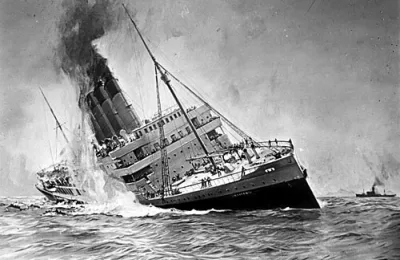
The RMS Lusitania, a British ocean liner, was sunk by a German U-boat on May 7, 1915, during World War I. The attack occurred in a declared war zone around the United Kingdom, three months after Germany announced unrestricted submarine warfare. Passengers were warned of the general danger, but the torpedo attack itself was without warning, leading to the ship sinking in just 18 minutes. Out of nearly 2,000 people aboard, only 763 survived, with 128 Americans among the deceased. This event significantly shifted global public opinion against Germany and is considered a contributing factor to the United States' eventual entry into the war.
Investigations into the sinking were complicated by wartime secrecy and propaganda. The ship was carrying a significant amount of war supplies, including ammunition and artillery shells, which fueled debates about the legitimacy of its sinking. Some theories suggest the British government deliberately risked the Lusitania to provoke the U.S. into joining the war, though mainstream historians generally dismiss this, attributing the loss to a combination of British errors and misfortune.
Background and Wartime Conversion Potential
Constructed with British government subsidies, the RMS Lusitania was designed with the potential for conversion into an armed merchant cruiser, featuring provisions for 12-inch guns and listed as a 'Royal Naval Reserve Merchant Vessel.' While initially considered by the Admiralty for requisition as an armed cruiser at the outbreak of World War I, this plan was abandoned. The significant coal consumption of large liners like the Lusitania made them a drain on Admiralty fuel reserves, rendering them less suitable for military roles compared to smaller cruisers. Their distinctive appearance also made them less ideal as troop transports compared to less recognizable vessels. As the immediate threat from the German Navy diminished, large passenger liners, including the Lusitania, were initially painted grey for camouflage during wartime crossings. However, as the Atlantic was deemed safer, and with sufficient bookings to justify operational costs, the Lusitania was returned to its civilian colors, with modifications like a bronze-colored band around the superstructure.
Escalating U-boat Threat and Declared War Zones
The British implemented a naval blockade of Germany at the start of World War I in August 1914, progressively expanding its list of contraband. By November 1914, the North Sea was declared a military area, with ships entering at their own risk unless following Royal Navy instructions. The emergence of U-boats as a threat to British shipping intensified in early 1915. Initially targeting naval vessels, German submarines began attacking merchant ships, though often adhering to older cruiser rules. In an effort to gain an advantage, Germany declared the seas around the British Isles a war zone on February 4, 1915, effective February 18, allowing Allied ships to be sunk without warning. While intended to avoid neutral ships, German Admiralty directives secretly encouraged targeting passenger vessels to deter shipping. The United States warned Germany of 'strict accountability' for any American casualties resulting from this campaign.
The Lusitania's Final Voyage and Controversial Sinking
Confusion and controversy surrounded the Lusitania's response to the declared war zone. American passengers on board urged Captain Daniel Dow to fly the U.S. flag, leading to diplomatic friction. The Admiralty issued specific instructions for the ship's safe passage, including assigning escorts, but communication issues and a deliberately false position provided by Captain Dow meant the warships could not locate the liner, which proceeded unescorted. Alterations were made to the Lusitania, possibly including painting its funnels dark grey to reduce visibility. The sinking on May 7, 1915, occurred after being struck by a single torpedo from the German U-20. A subsequent internal explosion caused the ship to sink rapidly. The presence of 173 tons of war supplies, including millions of rounds of ammunition and artillery shells, in the ship's hold at the time of its sinking has been a focal point of debate regarding the legitimacy of the attack and the responsibilities of various parties involved.
Key Ideas
- Debate surrounding the sinking of the Lusitania, including theories of deliberate provocation versus accidental tragedy.
- The role of unrestricted submarine warfare in World War I and its impact on international relations.
- The influence of propaganda and wartime secrecy on historical narratives and investigations.
Books by Barbara Kirschbaum
1 free public domain book · Read online or download