Avicenna
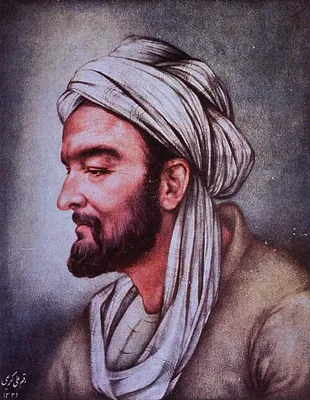
Avicenna was a preeminent Persian philosopher and physician of the Islamic Golden Age, renowned for his encyclopedic works.
Ibn Sina, known in the West as Avicenna, was a highly influential philosopher and physician from the Muslim world during the Islamic Golden Age. He served various Iranian rulers and significantly impacted medieval European thought in both medicine and philosophy. His contributions extended to numerous fields, including astronomy, alchemy, psychology, and mathematics. Avicenna's philosophical approach was rooted in the Peripatetic school, drawing heavily from Aristotelianism. He authored a vast collection of works, many of which survive today, solidifying his legacy as a polymath whose ideas bridged Eastern and Western intellectual traditions.
Born around 980 CE in present-day Uzbekistan, Avicenna received a comprehensive education from a young age, mastering subjects like the Quran, arithmetic, jurisprudence, and Greek sciences. He began his career as a physician at 17 and later held administrative positions. His life involved extensive travel and service across various Persian courts, including those in Bukhara, Gurganj, Ray, and Hamadan. During his career, he engaged in intellectual debates with contemporaries and developed his philosophical and medical theories, leaving behind a substantial corpus of writings in both Arabic and Persian.
Philosophical and Scientific Contributions
Avicenna's intellectual output spanned a remarkable range of disciplines. Beyond his renowned contributions to medicine and philosophy, he authored significant works on astronomy, alchemy, geography, geology, psychology, Islamic theology, logic, and mathematics. His philosophical system was deeply influenced by the Peripatetic tradition, building upon Aristotelian thought, and he is considered one of its foremost proponents within the Islamic world. He wrote extensively in Arabic, the lingua franca of scholarship at the time, but also produced key texts in Persian. His philosophical and scientific encyclopedia, The Book of Healing, and his medical encyclopedia, The Canon of Medicine, were foundational texts that profoundly influenced subsequent scholarly traditions in both the East and the West.
Medical Legacy
Avicenna is often hailed as the 'father of early modern medicine' due to the immense influence of his medical writings. His masterpiece, The Canon of Medicine, was a comprehensive medical encyclopedia that systematically organized medical knowledge. This work became a standard textbook in numerous medieval European universities and remained in use for centuries, with its influence extending as late as 1650. The Canon covered a vast array of medical topics, including anatomy, physiology, pathology, diagnosis, and treatment, reflecting a sophisticated understanding of the human body and disease for his era. His medical insights and systematic approach laid crucial groundwork for the development of Western medical science.
Intellectual Context and Education
Avicenna's intellectual development occurred during the vibrant Islamic Golden Age, a period marked by extensive study and translation of texts from Byzantine, Greco-Roman, Persian, and Indian traditions. He benefited from the scholarly atmosphere fostered by empires like the Samanids and Buyids, gaining access to significant libraries. His education was rigorous, starting with memorizing the Quran by age 10. He studied arithmetic with an Indian greengrocer, jurisprudence with a Hanafi jurist, and philosophy and medicine under prominent scholars like al-Natili and Abu Sahl al-Masihi. By 18, he had acquired a deep understanding of Greek sciences, demonstrating an exceptional capacity for independent learning and intellectual synthesis.
Books by Avicenna
2 free public domain books · Read online or download