Aurora Kane
Aurora Kane is an author associated with East Aurora High School, which has a rich history and notable alumni.
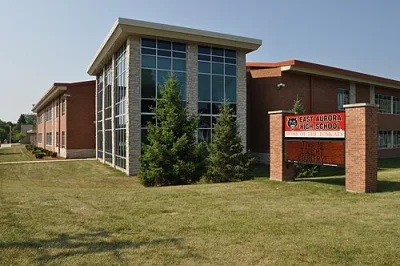
East Aurora High School, located in Aurora, Illinois, has a history dating back to early subscription schools in the 1830s. The first graduating class was in 1867, and the school has occupied several buildings throughout its existence, with the current campus opening in 1957. The school's athletic teams are known as the Tomcats, a nickname adopted by 1945, possibly in honor of coach Glen Thompson. The school offers a range of academic programs, including honors and AP classes, and participates in various athletic conferences and state competitions. It also has a significant presence in extracurricular activities and a large NJROTC program.
Historical Context
The educational landscape in East Aurora began with private subscription schools in 1834. East Aurora High School itself saw its first graduating class of four girls in 1867. The original high school building on Center Street was demolished in the 1960s. A significant development occurred in August 1912 with the opening of a new, larger facility on Jackson Street, which cost $225,000 and was attended by educational dignitaries for its dedication. This building now serves as K.D. Waldo Middle School. The present-day East Aurora High School campus was established in 1957 at 500 Tomcat Lane. Subsequent expansions after the 1989 school year added three stories to the east side for academic departments and new facilities like classrooms, a gym, and a cafeteria. Construction is ongoing on the west side for a new stadium.
Athletic Traditions and Rivalries
The East Aurora High School athletic teams officially adopted the 'Tomcats' nickname by 1945, a name that has become synonymous with the school's sports programs. The nickname may have originated from the popular football coach, Glen Thompson, known as 'Tommy,' who revitalized the team starting in 1925. The school boasts a strong athletic tradition, with 23 teams competing in various sports. Notable achievements include state placements in boys' basketball, girls' basketball, debate, boys' track and field (state champions in 1898), and boys' wrestling. The football rivalry between East Aurora and West Aurora High School is one of the oldest in the state, dating back to their first meeting in 1893. The 1938 Tomcat football team is particularly celebrated for its undefeated 9-0 season.
Academic Offerings and Extracurriculars
East Aurora High School provides a comprehensive academic curriculum, featuring Honors and Advanced Placement courses across subjects like foreign language, math, science, language arts, social studies, and fine arts. The school offers approximately 250 semester courses through eight major departments, supported by a staff of 178 teachers, 60% of whom hold advanced degrees. In terms of student performance, a 2012 report indicated an average composite ACT score of 16.6 and a graduation rate of 60.1 percent, with an average class size of 22.8 students. Beyond academics, the school fosters student engagement through a wide array of extracurricular activities, including clubs focused on arts, literature, technology, and leadership, as well as participation in scholastic competitions and publications like The Auroran school paper and the Speculum yearbook.
Notable Alumni and NJROTC Program
The school has produced a diverse range of notable alumni across various fields. Among them are figures in professional sports such as former NFL players Kurt Becker and Frank Hanny, NBA players Bob Lavoy and John Rennicke, and professional basketball player Ryan Boatright. The literary world is represented by authors Charles Pierce Burton and Olive Beaupré Miller, as well as Mabel O'Donnell, known for her educational readers. The school is also recognized for its significant Navy Junior Reserve Officers' Training Corps (NJROTC) program, which is the largest in the nation with over 900 students. The NJROTC unit has achieved considerable success, including multiple Area 3-West championships and national recognition as the 2006 National Color Guard Champions.
Books by Aurora Kane
4 free public domain books · Read online or download