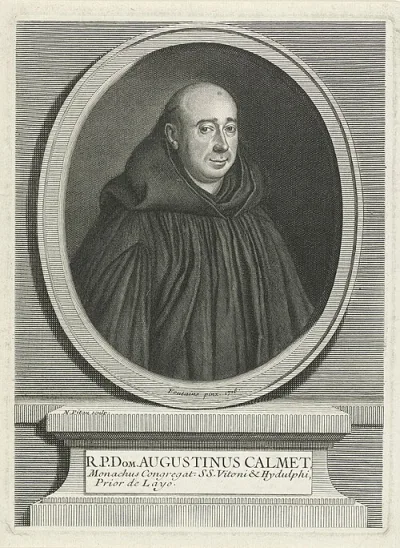
Augustin Calmet was a prolific French Benedictine abbot and scholar known for his biblical commentaries and extensive studies on supernatural phenomena.
Antoine Augustin Calmet (1672–1757) was a French Benedictine monk, abbot, and a highly respected scholar. Born in Lorraine, he joined the Benedictine order and pursued extensive studies in theology and biblical exegesis. He held various leadership positions within his congregation, including Abbot of Senones Abbey, where he spent the latter part of his life.
Calmet's scholarly output was vast, most notably his "Literal Commentary on all the Books of the Old and New Testaments." This monumental work, published in multiple editions and translated into several languages, was praised for its erudition and literal approach to scripture, though it also faced criticism for its handling of difficult passages. Beyond biblical scholarship, Calmet delved into the study of supernatural occurrences, magic, and witchcraft, compiling extensive dissertations on apparitions, demons, and revenants, which drew attention even from Enlightenment figures.
Biblical Scholarship
Augustin Calmet was a distinguished biblical scholar whose most significant contribution was his "Literal Commentary on all the Books of the Old and New Testaments." This extensive work, initially published in Paris in 1707 and eventually comprising twenty-three quarto volumes, aimed to provide a literal interpretation of scripture. It was highly regarded, even by Protestant scholars, and underwent several revised and expanded editions. Calmet's commentary was innovative in its focus on the literal meaning, departing from the prevalent practice of emphasizing allegorical and moral interpretations. A key component of his commentary were the introductory prefaces and 114 dissertations on specific topics, which he later published separately. These were translated into numerous languages, demonstrating the broad appeal and scholarly esteem of his biblical studies.
Studies on the Supernatural and Occult
Beyond his biblical work, Calmet conducted extensive research into supernatural phenomena, magic, and witchcraft. In 1746, he published "Dissertations sur les apparitions des anges, des démons et des esprits, et sur les revenants et vampires de Hongrie, de Bohême, de Moravie et de Silésie." This work systematically examined accounts of angelic and demonic apparitions, as well as revenants and vampires, drawing from biblical texts, mythology, folklore, and documented historical claims. Despite his critical approach, the study was comprehensive, encompassing various regions and drawing on a wide range of sources. This research was later expanded into a two-volume "Traité sur les apparitions des esprits et sur les vampires ou les revenants de Hongrie, de Moravie, &c." published in 1751, which ambiguously considered the possibility of supernatural entities.
Historical and Lexical Works
Calmet's prolific writing extended to historical and lexicographical works, many of which were closely linked to his biblical scholarship. He authored "Histoire de l'Ancien et du Nouveau Testament et des Juifs" (History of the Old and New Testaments and of the Jews), which saw multiple editions and translations. His "Dictionnaire historique, critique, chronologique, géographique et littéral de la Bible" (Historical, Critical, Chronological, Geographical, and Literal Dictionary of the Bible) was a significant reference work, published in multiple volumes and later expanded. Furthermore, Calmet contributed to the historical understanding of his native region with "Histoire ecclésiastique et civile de la Lorraine" (Ecclesiastical and Civil History of Lorraine) and compiled "Bibliothèque lorraine" (A Catalogue of the Writers of Lorraine), which included his autobiography. He also wrote commentaries on the Rule of Saint Benedict and a universal history.
Key Ideas
- Literal interpretation of biblical texts.
- Comprehensive study of supernatural phenomena, including apparitions, demons, and revenants.
- Compilation of historical and lexicographical data related to the Bible and Lorraine.
Notable Quotes
“Quoi ! C'est dans notre XVIIIe siècle qu'il y a eu des vampires ! C'est après le règne des Locke, des Shaftesbury, des Trenchard, des Collins; c'est sous le règne des d'Alembert, des Diderot, des Saint-Lambert, des Duclos qu'on a cru aux vampires, et que le RPD Augustin Calmet, prêtre, bénédictin de la congrégation de Saint-Vannes et de Saint-Hydulphe, abbé de Senones, abbaye de cent mille livres de rente, voisine de deux autres abbayes du même revenu, a imprimé et réimprimé l'Histoire des Vampires, avec l'approbation de la Sorbonne, signée Marcilli !”
Books by
4 free public domain books · Read online or download