Ascending Alchemy
The philosopher's stone, a legendary alchemical substance, was sought for its power to transmute metals and grant immortality.
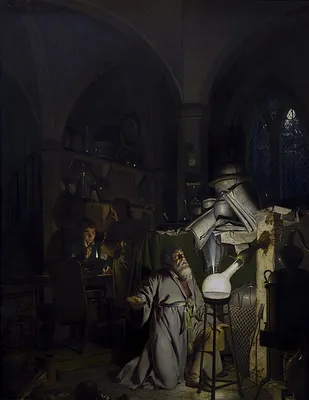
The philosopher's stone, also known as "the tincture" or "the powder," was a mythical alchemical substance believed to possess the power to transform base metals into gold or silver. Beyond its metallic applications, alchemists also theorized it could create an elixir of life, bestowing rejuvenation and immortality. For centuries, its discovery was the ultimate objective in alchemy, symbolizing perfection, divine enlightenment, and heavenly bliss, with the pursuit itself termed the Magnum Opus or "Great Work."
The concept of the philosopher's stone has ancient roots, with early mentions appearing around 300 AD, though some traditions claim its origin dates back to Adam. Its theoretical underpinnings can be traced to ancient Greek philosophy, incorporating ideas like the classical elements and the anima mundi. Throughout the Middle Ages and into the Renaissance, alchemists in various cultures, including Byzantine, Islamic, and European traditions, continued the quest, developing complex theories about elemental qualities and transmutation. Influential figures like Jabir ibn Hayyan and Paracelsus contributed significantly to these evolving alchemical doctrines. The stone also appears in Eastern traditions, notably as the Cintamani in Buddhism and Hinduism, embodying similar spiritual and transformative qualities.
Origins and Philosophical Roots
The earliest documented reference to the philosopher's stone dates to around 300 AD in the writings of Zosimos of Panopolis. However, certain alchemical traditions propose a much older history, suggesting its knowledge was divinely imparted to Adam and passed down through biblical patriarchs. The philosophical foundations for the stone's creation are deeply rooted in Greek thought. Alchemists drew upon concepts such as the classical elements, the anima mundi (world soul), and creation narratives found in texts like Plato's Timaeus. Plato's idea of the four elements originating from a prima materia, or first matter, was directly adopted by alchemists as the essential starting substance for their Great Work. This concept of a fundamental, primordial matter remained central to alchemical theory for centuries, with figures like Thomas Vaughan in the seventeenth century asserting that this universal first matter was identical to the first matter of the stone itself.
Medieval and Renaissance Developments
During the Middle Ages, alchemists in the Byzantine and Arab empires expanded upon earlier theories, focusing intently on the transmutation of metals. The eighth-century Muslim alchemist Jabir ibn Hayyan analyzed the classical elements and their qualities, proposing that metals were composed of these qualities and could be transformed by altering their balance. He theorized that a substance, known in Greek as xerion and Arabic as al-iksir (the origin of 'elixir'), mediated this change, often conceived as a red powder derived from the philosopher's stone. However, not all agreed; the 11th-century scholar Avicenna famously disputed the possibility of true transmutation. Later, figures like Albertus Magnus in the 13th century were associated with discoveries related to transmutation, though he did not explicitly claim to have found the stone. In the Renaissance, Paracelsus identified the philosopher's stone with the undiscovered element alkahest, the fundamental source of all other elements. The quest for the stone was also imbued with spiritual significance, as seen in Sir Thomas Browne's reflections and the symbolic instruction manual known as the Mutus Liber.
Eastern Parallels and Properties
The concept of a wish-fulfilling gem akin to the philosopher's stone exists in Buddhist and Hindu traditions, known as the Cintamani. In Mahayana Buddhism, it is associated with bodhisattvas and symbolizes wisdom and enlightenment, capable of transforming afflictions into spiritual awakening. Tibetan Buddhist traditions depict it as a luminous pearl. In Hinduism, the Cintamani is linked to deities like Vishnu and Ganesha and is often depicted as a jewel held by serpent kings or adorning the forehead of mythical creatures. The Yoga Vasistha contains a story about the stone, and Hindu sages like Sant Dnyaneshwar used it metaphorically for spiritual gnosis. The Shyāmantaka Mani is another legendary gem in Hindu mythology, said to bring prosperity and produce gold daily. The philosopher's stone itself was attributed numerous properties beyond metal transmutation, including healing, life extension, creating perpetual lamps, transforming common stones into gems, and even the creation of homunculi.
Key Ideas
- Transmutation of base metals into gold or silver.
- Creation of an elixir of life for rejuvenation and immortality.
- Symbol of perfection, divine illumination, and heavenly bliss.
- The Magnum Opus (Great Work) as the pursuit of the stone.
- Prima materia as the essential starting substance.
- Elemental theory and the qualities of substances.
- Spiritual and mystical interpretations of the alchemical quest.
Notable Quotes
“The smattering I have of the Philosophers stone, (which is something more than the perfect exaltation of gold) hath taught me a great deale of Divinity.”
“Those of the chemical craft know well that no change can be effected in the different species of substances, though they can produce the appearance of such change.”
“Unicornis est Deus, nobis petra Christus, nobis lapis angularis Jesus, nobis hominum homo Christus (One-horned is God, Christ the rock to us, Jesus the cornerstone to us, Christ the man of men to us.)”
“oure delycious stone”
Books by Ascending Alchemy
1 free public domain book · Read online or download