Arysio Santos
Plato's Atlantis is a fictional island used as an allegory for national hubris, later inspiring myth and pseudoscientific speculation.
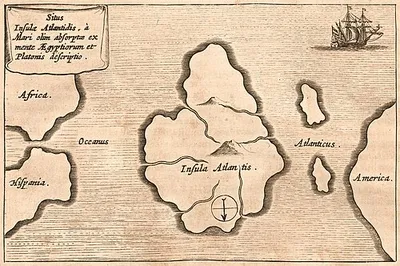
Atlantis, a legendary island first described by Plato in his dialogues "Timaeus" and "Critias," is presented as a powerful naval empire situated beyond the "Pillars of Hercules." Plato uses Atlantis as a literary device, contrasting its imperialistic hubris with an idealized ancient Athens. In his narrative, Atlantis is ultimately defeated by Athens and subsequently submerged into the ocean. While Plato intended the story as an allegory to champion his philosophical ideals of governance, its details have, over centuries, fueled considerable speculation. Despite modern scholarly consensus that Atlantis is fictional, its story has profoundly influenced literature and popular imagination, becoming a symbol for lost prehistoric civilizations and inspiring numerous fictional works.
Scholars debate the specific inspirations behind Plato's tale, with some suggesting influences from Egyptian records, the Sea Peoples invasion, or the Trojan War. Others argue that Plato drew more directly from contemporary events, such as the Athenian invasion of Sicily or the destruction of Helike. Regardless of its origins, Plato's account, transmitted through his dialogues, has been interpreted variously throughout history, from philosophical allegory to historical fact, leading to its enduring presence in myth and esoteric thought.
Plato's Allegory and Philosophical Intent
Plato introduced the island of Atlantis in his dialogues "Timaeus" and "Critias," framing it as a powerful naval empire that predated Athens by over 9,000 years. He described Atlantis as a vast landmass located beyond the Atlantic Ocean's known passages, which had conquered large parts of Europe and Africa. Plato's narrative contrasts this aggressive, expansionist empire with a fictionalized, ideal version of ancient Athens. This juxtaposition served Plato's philosophical purpose: to illustrate the superiority of his concept of an ideal state, as outlined in "The Republic," over a society corrupted by power and hubris. The story culminates in Atlantis's downfall, defeated by Athens and subsequently swallowed by the sea, serving as a cautionary tale about unchecked ambition and divine retribution.
Legacy and Esoteric Interpretations
Though Plato presented Atlantis as an allegory, its detailed description and purported ancient origins captured the imagination of later writers and thinkers. During the Renaissance, authors like Francis Bacon and Thomas More revisited the concept in utopian works. However, the 19th century saw a significant shift, with amateur scholars like Ignatius L. Donnelly reinterpreting Plato's narrative as historical fact. This led to widespread pseudoscientific speculation about Atlantis as an advanced prehistoric civilization. The vague geographical indicators and ancient timeline provided by Plato fueled these theories, making "Atlantis" a byword for lost, advanced cultures and continuing to inspire fiction across various media, from literature to film.
Scholarly Debate on Origins
Contemporary classicists and philologists largely agree that Plato's Atlantis is a fictional construct. However, debate persists regarding its potential inspirations. Some scholars suggest that Plato may have incorporated elements from older traditions, possibly drawing parallels with Egyptian records of the Thera eruption, the Sea Peoples migrations, or even the Trojan War. Others propose that Plato's account was more directly influenced by contemporary events, such as Athens' failed invasion of Sicily or the destruction of the city of Helike by an earthquake. The specific stylistic similarities between Plato's genealogy of Atlantean kings and the work of the logographer Hellanicus of Lesbos have also been noted, suggesting a possible literary borrowing or shared source material.
Key Ideas
- Allegory of national hubris and ideal governance
- Fictional powerful naval empire
- Submerged continent beyond the Pillars of Hercules
- Inspiration for utopian literature
- Subject of pseudoscientific speculation and lost civilization theories
Notable Quotes
“For it is related in our records how once upon a time your State stayed the course of a mighty host, which, starting from a distant point in the Atlantic ocean, was insolently advancing to attack the whole of Europe, and Asia to boot.”
“For the ocean there was at that time navigable; for in front of the mouth which you Greeks call, as you say, 'the pillars of Heracles,' there lay an island which was larger than Libya and Asia together; and it was possible for the travelers of that time to cross from it to the other islands, and from the islands to the whole of the continent over against them which encompasses that veritable ocean.”
“For all that we have here, lying within the mouth of which we speak, is evidently a haven having a narrow entrance; but that yonder is a real ocean, and the land surrounding it may most rightly be called, in the fullest and truest sense, a continent.”
“Now in this island of Atlantis there existed a confederation of kings, of great and marvelous power, which held sway over all the island, and over many other islands also and parts of the continent.”
“But afterwards there occurred violent earthquakes and floods; and in a single day and night of misfortune all your warlike men in a body sank into the earth, and the island of Atlantis in like manner disappeared in the depths of the sea.”
Books by Arysio Santos
1 free public domain book · Read online or download