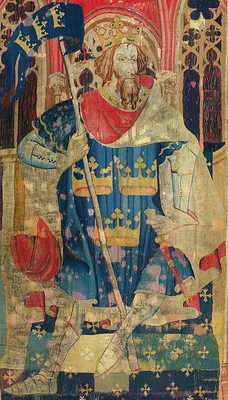
Arthur Pendragon
King Arthur is a legendary British leader from medieval literature, whose historical existence is debated among scholars.
King Arthur is a central figure in medieval British legend, known as the "Matter of Britain." Early Welsh accounts depict him as a warrior defending Britain against Anglo-Saxon invaders in the late 5th and early 6th centuries. While he first appears in historical sources like the Annales Cambriae and Historia Brittonum, these texts are from centuries after his supposed life, and most modern historians do not consider him a historical figure. His legend gained international prominence through Geoffrey of Monmouth's 12th-century "Historia Regum Britanniae," which introduced many elements now integral to the Arthurian story, such as Merlin, Excalibur, and Avalon. Later French romances, like those by Chrétien de Troyes, expanded the narrative, focusing on characters like the Knights of the Round Table and introducing the Holy Grail.
The historicity of Arthur has been a subject of academic debate since the 18th century. Some scholars interpret early sources as evidence of a historical Romano-British leader, pointing to mentions of battles like Badon and Camlann. However, the reliability and dating of these early texts are contested, and Arthur is notably absent from contemporary or near-contemporary accounts like Gildas's writings and Bede's "Ecclesiastical History," which instead name Ambrosius Aurelianus as a leader of the Britons. Many modern historians conclude there is insufficient evidence to support Arthur's existence as a historical figure, suggesting he may have originated as a folklore hero or even a deity who became associated with historical events.
Origins and Development of the Legend
The figure of King Arthur emerged as a legendary leader of post-Roman Britain, celebrated in the "Matter of Britain." Initial Welsh sources portray him as a formidable warrior combating Anglo-Saxon incursions in the late 5th and early 6th centuries. His earliest documented appearances are in the Annales Cambriae and Historia Brittonum, though these medieval compilations are dated roughly 300 years after his supposed lifetime, leading most contemporary historians to question his historical reality. Arthur's character evolved through Welsh mythology, sometimes depicted as a defender against earthly and supernatural threats, and at other times as a mystical figure linked to the Welsh otherworld, Annwn. The legend's widespread appeal was significantly boosted by Geoffrey of Monmouth's imaginative 12th-century "Historia Regum Britanniae," which established Arthur as an emperor who defeated the Saxons. This work introduced key narrative elements such as Uther Pendragon, Merlin, Guinevere, Excalibur, and the mystical isle of Avalon.
Historicity and Scholarly Debate
The historical existence of King Arthur has been a persistent topic of scholarly discussion. While traditionally accepted as a historical king or war commander, particularly from the 12th century onward, modern academic consensus largely refutes his historicity. Evidence cited by proponents, such as the Historia Brittonum listing twelve battles attributed to Arthur, and the Annales Cambriae linking him to the Battle of Badon (c. 516–518) and the Battle of Camlann where he and Mordred perished (c. 537–539), is often considered unreliable or misinterpreted. Crucially, Arthur is absent from significant contemporary or near-contemporary sources like Gildas's sixth-century account of Britain's ruin and Bede's early eighth-century history, which name Ambrosius Aurelianus as a leader at Badon. This lack of corroborating early evidence leads many historians to exclude Arthur from accounts of sub-Roman Britain, with some suggesting he may have originated as a folkloric hero or even a deity whose myth became attached to historical events.
Literary Evolution and Enduring Legacy
Beyond the question of his historical existence, Arthur's legend has profoundly shaped medieval literature and continues to resonate today. The development of Arthurian romance, significantly advanced by 12th-century French writers like Chrétien de Troyes, shifted narrative focus towards figures such as the Knights of the Round Table and introduced iconic elements like the Holy Grail. The themes and characters within Arthurian literature are diverse, lacking a single definitive version. While the legend experienced a decline after the Middle Ages, it saw a substantial revival in the 19th century and remains a prominent subject in contemporary culture, inspiring adaptations across various media including film, television, and comics. The enduring appeal of Arthur lies in its rich tapestry of heroism, magic, chivalry, and the complex interplay between myth and history.
Key Ideas
- The "Matter of Britain" as a medieval literary tradition centered on King Arthur.
- The debate over Arthur's historical existence versus his status as a legendary or mythological figure.
- The evolution of Arthurian legend through Welsh mythology, Geoffrey of Monmouth's chronicles, and French romances.
- The absence of Arthur from key contemporary historical sources as evidence against his historicity.
Books by Arthur Pendragon
2 free public domain books · Read online or download