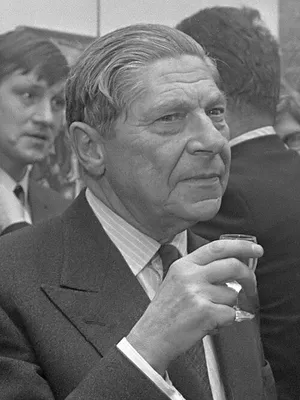
Arthur Koestler
Arthur Koestler was a Hungarian-born author and journalist known for his anti-totalitarian novels and essays on various political and philosophical subjects.
Born in Budapest in 1905, Arthur Koestler was an author and journalist of Austro-Hungarian descent. He joined the Communist Party of Germany in 1931 but left in 1938 due to disillusionment with Stalinism. After moving to Britain in 1940, Koestler achieved international acclaim with his anti-totalitarian novel "Darkness at Noon." Over the subsequent decades, he engaged in numerous political causes and produced a diverse body of work including novels, memoirs, biographies, and essays. From 1949, he secretly collaborated with the British Information Research Department, a Cold War propaganda unit that promoted his writings. Koestler received recognition for his contributions to European culture, including the Sonning Prize in 1968 and a CBE in 1972.
Koestler's early life involved a privileged upbringing in Budapest, with his family experiencing the upheaval of World War I and the Hungarian Revolution of 1919. He pursued engineering studies at the University of Vienna before leaving for Mandate Palestine in 1926. In Palestine, he worked various jobs and wrote for publications, eventually becoming a correspondent for the Ullstein-Verlag group. He later worked in Berlin and Paris for Ullstein, reporting on scientific matters and even accompanying a polar flight on the Graf Zeppelin. His political leanings shifted towards Marxism-Leninism, leading him to join the Communist Party of Germany. His experiences in the Soviet Union, including witnessing a man-made famine, later shaped his critical views. Koestler also participated in anti-fascist activities and covered the Spanish Civil War.
Early Life and Political Awakening
Arthur Koestler was born in Budapest in 1905 to Jewish parents. His family, though experiencing financial fluctuations and the impact of World War I, maintained a comfortable lifestyle. Koestler's early education included experimental kindergartens and later university studies in engineering in Vienna. However, financial difficulties and a desire for experience led him to leave Austria for Palestine in 1926. During his time in Palestine, he worked various jobs and began his journalistic career, writing for local and international publications. He also had a brief stint with a Zionist party in Berlin before returning to journalism for the Ullstein-Verlag group. His work took him across the Middle East, and he later moved to Berlin and Paris, covering scientific and political events. Influenced by the perceived strength of the Soviet Union and the rise of Nazism, Koestler joined the Communist Party of Germany in 1931.
Journalism, Soviet Union, and Anti-Fascism
Koestler's career as a journalist expanded significantly in the early 1930s. He was the sole journalist on the Graf Zeppelin's polar flight in 1931, gaining further public recognition. His time in the Soviet Union around 1932-1933 provided him with firsthand, albeit censored, experiences that would later inform his critical perspectives. He traveled through Turkmenistan and the Ukrainian SSR, witnessing the devastating effects of a man-made famine, though he initially echoed official Soviet narratives. Following Hitler's rise to power, Koestler left the Soviet Union and became active in anti-fascist movements in Paris, working under Comintern propaganda director Willi Münzenberg. He married fellow communist Dorothy Ascher in 1935. His involvement in the Spanish Civil War in 1936, where he posed as a Franco sympathizer to gather information for the Comintern, highlighted his deep engagement in the political conflicts of the era.
Literary Career and Later Life
After leaving the Communist Party in 1938, Koestler moved to Britain in 1940. It was there he published "Darkness at Noon," a powerful novel against totalitarianism that brought him international fame. For the next four decades, Koestler produced a prolific output of novels, memoirs, biographies, and essays, exploring a wide range of political and philosophical themes. He also engaged in secret work for the British government's Information Research Department, a Cold War anti-communist propaganda unit, which distributed his writings and supported his activities. Koestler received accolades for his cultural contributions, including the Sonning Prize and appointment as a Commander of the Order of the British Empire. Diagnosed with Parkinson's disease and later terminal leukemia, Arthur Koestler and his wife died by suicide together in London in 1983.
Key Ideas
- Critique of totalitarianism
- Disillusionment with communism
- Exploration of political and philosophical themes
Books by Arthur Koestler
3 free public domain books · Read online or download