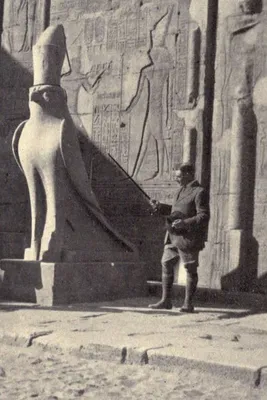
Arthur Edward Pearse Brome Weigall
Arthur Weigall was an English Egyptologist, journalist, and author with a diverse career spanning ancient history, stage design, and popular fiction.
Arthur Edward Pearse Brome Weigall (1880–1934) was a multifaceted English figure whose career encompassed Egyptology, journalism, stage design, and authorship. Born into a society family, his early life involved an unconventional upbringing and education, leading him to Egyptology through an interest in genealogy. He worked under prominent Egyptologists like Flinders Petrie and Friedrich Wilhelm von Bissing before being appointed Chief Inspector of Antiquities for Upper Egypt at a young age, succeeding Howard Carter.
During his tenure in Egypt, Weigall was dedicated to the preservation of ancient monuments and participated in significant archaeological discoveries, including several tombs. His scholarly pursuits were complemented by his writing, producing works on Egyptian history and biographies. Following a breakdown and the onset of World War I, he returned to England and transitioned into stage design and film criticism. He later returned to Egypt as a journalist, notably covering the opening of Tutankhamun's tomb and clashing with Howard Carter and Lord Carnarvon over press access. Weigall's personal life included two marriages, the first coinciding with his writings on Egypt and the second linking him to the entertainment world through his wife's family and his own lyric writing.
Early Life and Entry into Egyptology
Arthur Weigall's life began in 1880, the same year his father passed away in British India. He came from a family with artistic and aristocratic connections. His mother worked as a missionary after his father's death. Weigall's education at Wellington College and early work as an apprentice clerk were followed by a burgeoning interest in genealogy, which ultimately steered him towards the study of Ancient Egypt. A supportive patroness encouraged him to pursue higher education, though his initial attempt to study Egyptology at Oxford proved premature. He then traveled to Leipzig, intending to study German and enroll in a university there, but this plan did not materialize. Upon returning to England, he found employment with the renowned Egyptologist Flinders Petrie, working first in London and later at an archaeological site in Abydos, Egypt.
Career in Egypt and Archaeological Contributions
After a challenging period working with Flinders Petrie, Weigall moved to work with Friedrich Wilhelm von Bissing. In 1905, he stepped into a significant role when Howard Carter resigned as Chief Inspector of Antiquities for Upper Egypt. At just 25 years old, Weigall was appointed to this position in Luxor, overseeing a vast territory responsible for safeguarding antiquities. He dedicated himself to protecting and conserving ancient monuments, many of which were being acquired and moved abroad. His time in Luxor was highly productive, marked by his involvement in the excavation of notable tombs such as KV46, TT8, KV55, and KV57. He also explored the Eastern Desert and authored a popular biography of Akhenaten, alongside a guide to the antiquities of Upper Egypt. Weigall collaborated with Alan Gardiner and may have assisted Howard Carter in securing the position that led to the discovery of Tutankhamun's tomb. He was deeply integrated into the social and administrative circles of Egypt, forming connections with prominent figures and enjoying friendships within Edwardian society.
Transition to Arts and Journalism
A period of ill health led Weigall to leave Egypt, and the outbreak of World War I disrupted his ambitions for establishing an Egyptian institute of Egyptology. During the war, he found success in London as a stage designer for revue productions. His engagement with the arts extended to the burgeoning film industry; he worked on the film 'Her Heritage' and later served as a film critic for the Daily Mail. One of his novels was adapted into the film 'Burning Sands.' His journalistic career brought him back to Egypt, where he covered the highly publicized opening of Tutankhamun's tomb for the Daily Mail. Weigall publicly disagreed with the exclusive arrangements made by Howard Carter and Lord Carnarvon with The Times, viewing it as detrimental to British-Egyptian relations during a time of Egyptian nationalism.
Later Life and Literary Pursuits
Arthur Weigall passed away in 1934. His first marriage, to Hortense Schleiter, an American, coincided with his writing of descriptive personal accounts of his experiences in Luxor and Upper Egypt. His second marriage, to pianist Muriel Lillie, brought him back into contact with the world of entertainment. Through this connection, he became a writer of lyrics, further diversifying his creative output. His literary contributions spanned various genres, including historical biographies, guidebooks, and popular novels, reflecting the breadth of his interests and experiences.
Notable Quotes
“if he goes down in that spirit, I give him six weeks to live”
Books by Arthur Edward Pearse Brome Weigall
1 free public domain book · Read online or download